

 The Honkyoku pieces (solo traditional pieces written by monks) have no fixed rhythm. The rhythm is based on the length of the breath, the amount of notes you have to play in one breath and how you use your breath. The tradition transmitted from a master gives indications how to place the tones within a breath. It can vary from a player to the other, but also from one day to the next.
How about silence? Continue reading The Rhythm of Silence
Tag Archives: Japanese traditional music

September 2017
My last visit to the dementia care house was nice again. It sounds quite repetitive if you’ve read my other posts about my visits, although it is each time different. I never know what is going to happen and I am always a little bit nervous what to expect. How can you prepare yourself to the unexpected?
Last time, I was in a busy period, I was tired, I wanted things to get done, and there I stand, waiting for A. to finish an endless conversation with people of the department, starting to get annoyed, thinking “this has nothing to do with me, I have so many other things to do”. And then I take my flute out of my bag and start to play to warm up, which I normally never do because I don’t need to, but today I do. It is not to warm up the flute, it is for me to calm down, to open my heart and be ready to meet the patients. And it works. A few breaths and my stress is gone, the outside world can wait, I’m happy to be here, I’m ready.
Performances
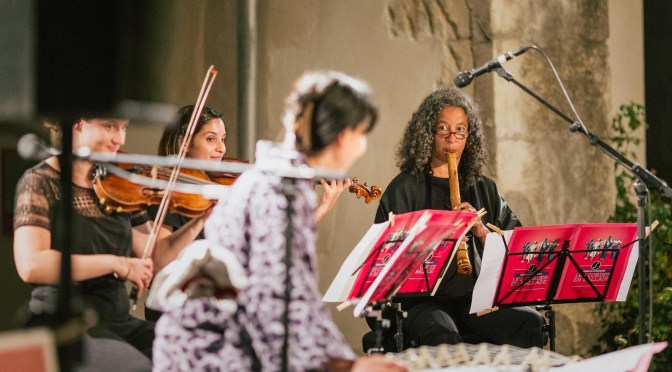
I’ve been performing since I’m fifteen, and I’ve never learned how to do it. I didn’t even think there was something to learn about it. However, when you think back to how many people get nervous when they have to perform, from good anxiety to total panic that they have to calm down with medicines or even stronger stuff, you start to ask yourself whether there might be somehow something to learn about it. I can still remember moments of total panic during competitions and it didn’t feel good. Playing music shouldn’t lead to this amount of stress. At a lower level, I also experienced the frustration of practicing so hard for a lesson and then not being able to play the way I wanted when in presence of my teacher and the other students. So, is there something you can do about it?
ESS Summer School 2017
In a few days the annual European Shakuhachi Summer School will begin gathering almost 60 shakuhachi aficionados (teachers and participants) together from all over Europe and with Maekawa Kogetsu as an representation of Myōan and Kinpū ryū. And it all happens in the small provincial town Vejle, Denmark – out in the fringes of Europe. Hurray for celebrating shakuhachi all over Europe! See you there! Kiku Day, Chair of the ESS.
I’m very honoured to be invited to this ESS Summer School where I will teach solo and group pieces from our Hijiri-kai school. The venue is a boarding school, which will enable us to blow and spend time together as a group. There will be a lot of different styles represented, traditional and modern music, solo and chamber music, pieces with koto, improvisation and original compositions. It is a great opportunity to listen to a lot of music and meet each other.
Although a big part of the traditional repertoire of shakuhachi consists in solo pieces (honkyoku), blowing together is very important in our school. Fukuda-sensei is tirelessly writing new pieces and arrangements for us when we gather in the Summer Schools organised in France by Daniel Lifermann for La Voie du Bambou. I’m very pleased to share some of his music and the spirit of it this summer in Denmark.
These pieces are meant to be performed by players of all levels, everyone playing according to his capacities. Generally, there isn’t a fixed rhythm except the rhythm of the breath (like in most of the honkyoku music), which allows some fuzziness, like a natural echo or reverberation. Playing together means listening to each other in order to tune in one multiple voice. It’s very good to confront your pitch control with the others’!
Here are the pieces: Continue reading ESS Summer School 2017

Flutes
It’s not always easy to find the right instrument, like to find the right partner for life. Sometimes you have to travel far away.
I started music with the recorder lessons of the primary school and I loved it (while most of my friends didn’t). But at that time, my fascination went to the piano, because of my mother’s LP’s I liked so much to listen to. Piano at home was no option so I ended up learning transverse flute at the local music school. When I was around 15, my godmother showed me that there existed other flutes in the world with bringing me back a flute from Nepal. Couldn’t do much with it but I found it nice with its decorations. Some years later, when I heard a musician playing a kind of transverse flute in Senegal, I went to meet him and bought one of his flute. My collection had started. The sound of this flute still evokes the memory of the land where I was born.


Inspiration
April 25 – May 23
Back today to the dementia care home where I’ve been playing for elderly people since 2014. Between today and my last visit on April 25, I gave three very different performances: the Requiem of Jenkins in the concert hall in Middelburg with orchestra, choir and soloist ; the musical show “Fureidesu” with the storyteller Gerard Jellema in Rotterdam, and the opening of the exhibition “Les Petites Peurs” by S.P.A.M. van Griensven also in Rotterdam. Different places, different audiences, different ways of listening, different ways of playing. And here I am today, back in Nijmegen for my monthly visit to the elderly people cuddling their Teddy bears, playing with toys and desperately roaming in the corridors trying to find their way home.
What a difference.
What am I going to play today?

Agenda May-July 2017
In the coming months, I’ll be performing in 5 different projects, which shows the diversity of possibilities of playing shakuhachi:
The Requiem of Karl Jenkins, May 4 in Middelburg (NL), Japanese tales, May 12 in Rotterdam and July 2 in Den Helder (NL), Les Petites Peurs, mixed media installation, May 20 in Rotterdam (NL), Les Cordes en Ballade, classical music festival, July 11 in Bourg-St-Andéol (FR) and The European Shakuhachi Society Summer School, July 27-30 in Vejle (DK).
Japan
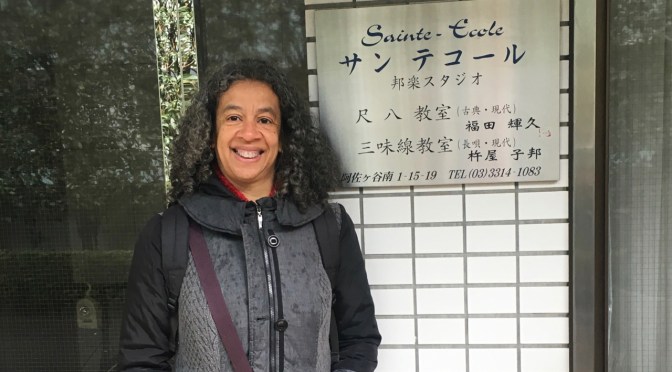
Going to Japan was an old dream. Since I met Fukuda Teruhisa Sensei in 2006, I was looking forward to the day I could fly again to Tokyo and study with him there. Life took its time to make this trip possible. Preparing it was already great. Doing it was overwhelming.
I’m back since a few days, after 3 weeks of travel and experiences. I didn’t have time to write and post when I was there. I always need time to reflect on my experiences.
What attracts me most in the shakuhachi, what touches me most beyond its fabulous sound, is the spirituality and the nature. Maybe they are both the same for me. Being in nature is meditating. I sometimes go to the the forest nearby where I live with a head full of thoughts, and I come back with a head full of birds’ songs.
Inspiration
Playing a traditional music which isn’t from your own country is like speaking a foreign language. Going to Japan was going to the source of this language and trying to discover and feel what inspired the people who created this music. Quite a program. In two parts. Tokyo, for the shakuhachi lessons, the culture, the modern life. Hokkaido for the nature. There were both as inspiring.

Blowing together
Last weekend, I gave two workshops about blowing together, which is an important part of our practice in the Hijiri-ryū.
Blowing together means learning to listen to yourself and to the others at the same time. It isn’t always easy to hear your own sound among all the other sounds, but you’ll notice that the sensation of your own vibration will increase, and a new “internal ear” will be activated. It’s a matter of letting go of yourself to join the breath and sound of the others, and find your own voice inside the group.
The shakuhachi is very challenging on this aspect because it is mainly played solo, or with strings instruments (koto / shamisen) which have a more stable intonation. The fluctuations of the shakuhachi and the stability of the strings complement one another. In a group of shakuhachi, the first difficulty when you play with others is the stability of your own sound, and then, your capacity of embouchure control and adaptation to the “common pitch”. The common point of all players is the breath. Blowing together, even if the lengths of breath are different, becomes a way of supporting each other. It asks concentration to find the right balance in the group, but gives so much energy back. And the best reward is the music you can share.

Hijiri 聖 shakuhachi
I sometimes get questions about the style I play and the school I belong to. As I don’t speak Japanese, I searched for a translation of the term “Hijiri” and here is what I found (Encyclopedia Britannica):
Hijiri, (聖, Japanese: “holy man”), in Japanese religion, a man of great personal magnetism and spiritual power, as distinct from a leader of an institutionalized religion. Historically, hijiri has been used to refer to sages of various traditions, such as the shaman, Shintō mountain ascetic, Taoist magician, or Buddhist reciter. Most characteristically hijiri describes the wandering priest who operates outside the orthodox Buddhist tradition to meet the religious needs of the common people.
 Hélène Seiyu 聖 優 Shakuhachi