

Shakuhachi is often unpredictable in the beginning. Some days are better than others. In the same practice session, you have good moments and a few minutes later, you cannot make any sound anymore. It can be frustrating. Although there is no chance involved there, but a combination of subtle factors you will learn to master better and better with your practice. Concentrating on the mouth, lips, head position is necessary, but not sufficient. When you play shakuhachi, your entire body gets involved. The flute should become a part of your body. The sound you make comes from deep under in your belly, not only from your mouth and lips. It starts with your inhalation. So a good body posture is an important factor one shouldn’t underestimate, especially in the beginning. Here are some tips to keep in mind when you practice:
Tag Archives: Japanese bamboo flute
Japan
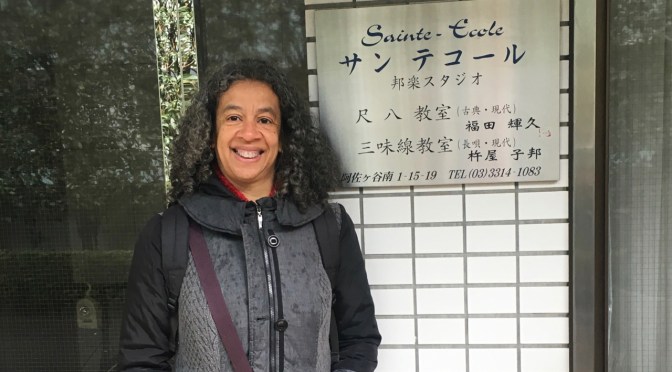
Going to Japan was an old dream. Since I met Fukuda Teruhisa Sensei in 2006, I was looking forward to the day I could fly again to Tokyo and study with him there. Life took its time to make this trip possible. Preparing it was already great. Doing it was overwhelming.
I’m back since a few days, after 3 weeks of travel and experiences. I didn’t have time to write and post when I was there. I always need time to reflect on my experiences.
What attracts me most in the shakuhachi, what touches me most beyond its fabulous sound, is the spirituality and the nature. Maybe they are both the same for me. Being in nature is meditating. I sometimes go to the the forest nearby where I live with a head full of thoughts, and I come back with a head full of birds’ songs.
Inspiration
Playing a traditional music which isn’t from your own country is like speaking a foreign language. Going to Japan was going to the source of this language and trying to discover and feel what inspired the people who created this music. Quite a program. In two parts. Tokyo, for the shakuhachi lessons, the culture, the modern life. Hokkaido for the nature. There were both as inspiring.
Young people with dementia, 2014
One reason I started this blog is to write about my visits to people with dementia, visits I started in April 2014. Playing shakuhachi for them is a strong and inspiring experience. From the very first day, I felt the urge to write about it, to talk about them. And I started to collect stories.
Although I mainly play for old people, I sometimes visit another building where the “young people” live. Quite a shock to realise that some of them are around my age. I only knew Alzheimer’s disease as the most common cause of dementia. With my visits to the Young people, I discovered Pick’s disease, a disease where symptoms begin in people between the ages of 40 and 60. Different age, different behaviour, different stories.
Here is a text I wrote in October 2014.
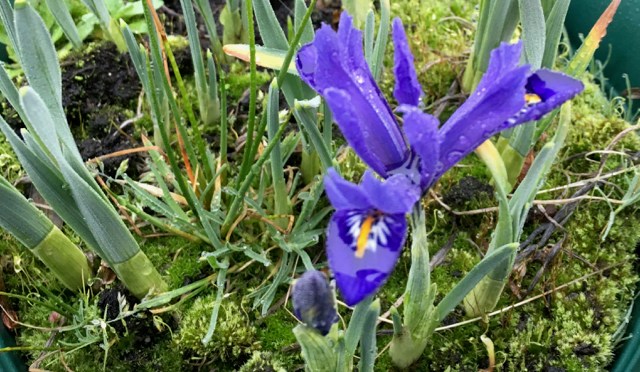
Iris, March 2017
Monthly visit at the dementia care home
From my audience in the department called “Iris”, two people passed away. One of them was Mrs Kisses. She was 90. I’m happy to have met her, to have had time to write a few lines about her, and to remember her thanks to the nickname I gave her, which instantly brings back memories, which her real name doesn’t. I won’t forget her kisses.
Sakura Sakura (Cherry Blossoms)
It was a grey rainy day so I decided to play the song Sakura Sakura, with all kind of variations and introductions, to bring some Spring feeling to the patients. That was much appreciated. It feels good to see that the seasons still mean something to the patients, even though most of them don’t go outside anymore.

Karl Jenkins – Requiem
The Requiem (2004) of Karl Jenkins is a very special piece to me. It is written for orchestra and choir (with a soprano solo part) and shakuhachi. In addition to the usual movements of a Requiem (Latin mass for the soul of the dead), Jenkins chose 5 Japanese haikus (poems) about the cycle of life and death. These poems are sung by the women of the choir, accompanied by the orchestra and a solo shakuhachi part. The music is written in Western notation, and can be played by a transverse flute instead, if there is no shakuhachi player. Of course, the effects and colours are then totally different. The Western notation allows the shakuhachi player to choose his/her own fingerings and lengths of flutes and go deeper in the music by making his/her own interpretation. This piece allows me to use my classical background as a flutist to perform Japanese shakuhachi in a classical music setting, uniting my two musical worlds.
I’ll be performing this piece on March 18 in Ede and on May 4 in Middelburg (The Netherlands). A nice opportunity for the audience to discover the shakuhachi “live”.


Blowing together
Last weekend, I gave two workshops about blowing together, which is an important part of our practice in the Hijiri-ryū.
Blowing together means learning to listen to yourself and to the others at the same time. It isn’t always easy to hear your own sound among all the other sounds, but you’ll notice that the sensation of your own vibration will increase, and a new “internal ear” will be activated. It’s a matter of letting go of yourself to join the breath and sound of the others, and find your own voice inside the group.
The shakuhachi is very challenging on this aspect because it is mainly played solo, or with strings instruments (koto / shamisen) which have a more stable intonation. The fluctuations of the shakuhachi and the stability of the strings complement one another. In a group of shakuhachi, the first difficulty when you play with others is the stability of your own sound, and then, your capacity of embouchure control and adaptation to the “common pitch”. The common point of all players is the breath. Blowing together, even if the lengths of breath are different, becomes a way of supporting each other. It asks concentration to find the right balance in the group, but gives so much energy back. And the best reward is the music you can share.

De Brug, February 14, 2017
In the dementia care home where I regularly play shakuhachi,”De Brug”, The Bridge, is the first department of the closed area. The people I see there walking around have still a foot in the outside life and the other foot… well, it looks like they don’t exactly know where they are. They are still looking for their husband or wife, wanting to go back home to prepare dinner, worrying about their mother to visit or their children to pick up at school. One woman asks us today where the busstop is to go to the city center. When she realises she doesn’t have money to pay her ticket, she doesn’t know what to do anymore. She eventually goes back to her bedroom. They don’t always remember where their bedroom is. They don’t feel home.

Hijiri 聖 shakuhachi
I sometimes get questions about the style I play and the school I belong to. As I don’t speak Japanese, I searched for a translation of the term “Hijiri” and here is what I found (Encyclopedia Britannica):
Hijiri, (聖, Japanese: “holy man”), in Japanese religion, a man of great personal magnetism and spiritual power, as distinct from a leader of an institutionalized religion. Historically, hijiri has been used to refer to sages of various traditions, such as the shaman, Shintō mountain ascetic, Taoist magician, or Buddhist reciter. Most characteristically hijiri describes the wandering priest who operates outside the orthodox Buddhist tradition to meet the religious needs of the common people.

Shakuhachi and dementia: how it started
April 2014
I’m starting a volunteer job in a dementia care home, playing shakuhachi for the people in their bedrooms (individual visits) and during a massage activity (small group). I’ve never done that before and don’t know what to expect. I’m told that the goal is to connect to the patients, in one way or another, to reach them through the music. All kind of emotions can occur. “Don’t insist if they don’t want it or if it’s not the right moment, and don’t take it personal if they react negatively.” That was my formation for this job. Let’s do it!
Daily meditation with the shakuhachi
Meditation with shakuhachi is different than practicing or performing. There is no artistic goal. It is full concentration and full acceptation, without judgement. I have a few standard exercises to get started, and, depending on the days, I like to experiment and try new things. I generally put on a timer and decide how long I’m going to practice.
Continue reading Daily meditation with the shakuhachi Hélène Seiyu 聖 優 Shakuhachi