Tag Archives: Honkyoku

ESS Summer School 2017

In a few days the annual European Shakuhachi Summer School will begin gathering almost 60 shakuhachi aficionados (teachers and participants) together from all over Europe and with Maekawa Kogetsu as an representation of Myōan and Kinpū ryū. And it all happens in the small provincial town Vejle, Denmark – out in the fringes of Europe. Hurray for celebrating shakuhachi all over Europe! See you there! Kiku Day, Chair of the ESS.

I’m very honoured to be invited to this ESS Summer School where I will teach solo and  group pieces from our Hijiri-kai school. The venue is a boarding school, which will enable us to  blow and spend time together as a group. There will be a lot of different styles represented, traditional and modern music, solo and chamber music, pieces with koto, improvisation and original compositions. It is a great opportunity to listen to a lot of music and meet each other.
Although a big part of the traditional repertoire of shakuhachi consists in solo pieces (honkyoku), blowing together is very important in our school. Fukuda-sensei is tirelessly writing new pieces and arrangements for us when we gather in the Summer Schools organised in France by Daniel Lifermann for La Voie du Bambou. I’m very pleased to share some of his music and the spirit of it this summer in Denmark.
These pieces are meant to be performed by players of all levels, everyone playing according to his capacities. Generally, there isn’t a fixed rhythm except the rhythm of the breath (like in most of the honkyoku music), which allows some fuzziness, like a natural echo or reverberation. Playing together means listening to each other in order to tune in one multiple voice. It’s very good to confront your pitch control with the others’!
Here are the pieces: Continue reading ESS Summer School 2017

Summertime

It was very hot when I went to the dementia care house last Tuesday for my monthly visit to the elderly people there. They were sheltering in the shadow and the first group I visited was watching a documentary with pictures of mountains and snow. How refreshing! They weren’t that happy when A. turned off the television and even though I played some music from the north of Japan, it was challenging to pass on to them through my breath a feeling of cool air. Most of them did appreciate my musical interlude though, especially a tiny old woman, Mrs M., cuddling a big cuddle dog she always carries around. She loves music and spontaneously hums along with an evident pleasure. Two people were sleeping and two others were waiting to get the television back, but she was the one who was going to give me the biggest surprise of the day. Continue reading Summertime

Inspiration

April 25 – May 23

Back today to the dementia care home where I’ve been playing for elderly people since 2014. Between today and my last visit on April 25, I gave three very different performances: the Requiem of Jenkins in the concert hall in Middelburg with orchestra, choir and soloist ; the musical show “Fureidesu” with the storyteller Gerard Jellema in Rotterdam, and the opening of the exhibition “Les Petites Peurs” by S.P.A.M. van Griensven also in Rotterdam. Different places, different audiences, different ways of listening, different ways of playing. And here I am today, back in Nijmegen for my monthly visit to the elderly people cuddling their Teddy bears, playing with toys and desperately roaming in the corridors trying to find their way home.

What a difference.

What am I going to play today?

Continue reading Inspiration

Japan

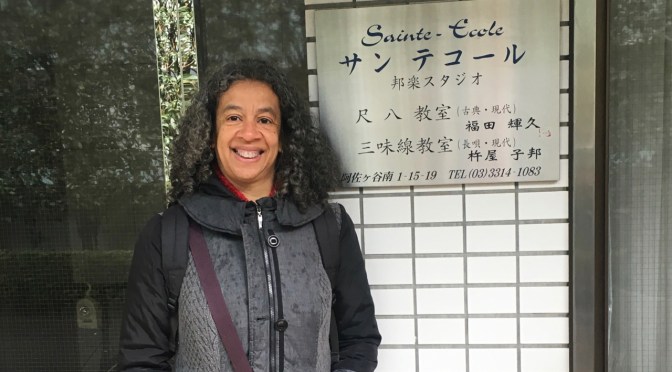
Going to Japan was an old dream. Since I met Fukuda Teruhisa Sensei in 2006, I was looking forward to the day I could fly again to Tokyo and study with him there. Life took its time to make this trip possible. Preparing it was already great. Doing it was overwhelming.

I’m back since a few days, after 3 weeks of travel and experiences. I didn’t have time to write and post when I was there. I always need time to reflect on my experiences.

What attracts me most in the shakuhachi, what touches me most beyond its fabulous sound, is the spirituality and the nature. Maybe they are both the same for me. Being in nature is meditating. I sometimes go to the the forest nearby where I live with a head full of thoughts, and I come back with a head full of birds’ songs.

Inspiration

Playing a traditional music which isn’t from your own country is like speaking a foreign language. Going to Japan was going to the source of this language and trying to discover and feel what inspired the people who created this music. Quite a program. In two parts. Tokyo, for the shakuhachi lessons, the culture, the modern life. Hokkaido for the nature. There were both as inspiring.

Continue reading Japan

Blowing together

Last weekend, I gave two workshops about blowing together, which is an important part of our practice in the Hijiri-ryū.

Blowing together means learning to listen to yourself and to the others at the same time. It isn’t always easy to hear your own sound among all the other sounds, but you’ll notice that the sensation of your own vibration will increase, and a new “internal ear” will be activated. It’s a matter of letting go of yourself to join the breath and sound of the others, and find your own voice inside the group.

The shakuhachi is very challenging on this aspect because it is mainly played solo, or with strings instruments (koto / shamisen) which have a more stable intonation. The fluctuations of the shakuhachi and the stability of the strings complement one another. In a group of shakuhachi, the first difficulty when you play with others is the stability of your own sound, and then, your capacity of embouchure control and adaptation to the “common pitch”. The common point of all players is the breath. Blowing together, even if the lengths of breath are different, becomes a way of supporting each other. It asks concentration to find the right balance in the group, but  gives so much energy back. And the best reward is the music you can share.

Continue reading Blowing together

Music recordings (2)

A quick post in addition to my previous one, Music recordings.
I’ve been quite busy this week recording myself and listening back… and you? What I notice, and noticed already before, is that the more you record yourself, the less you have surprises when you listen back. Sounds logical. I like to see the shakuhachi as a mirror of yourself, of your inner self. How you are doing, feeling: stressed, tired, excited, quiet, happy… But also on an external aspect, listening back to yourself is like looking at your image in a mirror. If you are really concentrated and listening to yourself when you record, you shouldn’t be too much surprised of the outcome. How carefully are you listening to yourself when you play? How carefully are you listening to your breathing and your silences, which are also part of your music?

Learning is listening. Teaching is listening.

This is what I recorded yesterday. Just for sharing, I’m still working on this piece (Ifu-Saji). Recording myself (and learning by heart) helps me a great deal to go deeper in the piece. Feel free to give constructive feedback.


A nature funeral

She lies in her bed, in the living-room, close to the window with view on the garden. I’m playing for her, from a distance, very softly, I don’t even see her under the blankets. I don’t know if she can hear me. In a couple of weeks, she will be dead.

I met the family in a sunny afternoon of October, after I received a unusual and touching email. “My wife is dying, she asks for live shakuhachi music to be played at her funeral, is this something we can ask you?”  Continue reading A nature funeral

Christmas Spirit

I grew up in a catholic family and although I’m no believer myself, Christmas has always been for me an important symbol of peace and reconciliation. As a child, my favourite Christmas songs were those of The Poppys, a group of French children singing about love, world peace, and against war. I hadn’t listened to these songs for years, but they still move me while listening to them again so many years later, because there’re performed with all the faith and sincerity of children’ hearts, the very same feelings I had in my own child’s heart.
Continue reading Christmas Spirit

6 good reasons to learn shakuhachi

6 good reasons to learn shakuhachi

1. It is a very special instrument: its sounds is unique and will open a new world for you.

2. It is a deep breathing training: bringing your awareness to your breath is relaxing and a deep breathing training is very good for your health. It will help you find a quiet moment for yourself.

3. It is a challenging instrument:

  • physically: to get a sound, to keep it, to get the proper pitch.
  • mentally: to go on and don’t give up because it’s more difficult than what you thought. You can do it.
  • energetically: it’s a mirror of your energy level, and it will help you to improve it.
  • spiritually: you’ll have to let go of your self and accept what is given by the flute. Playing the old traditional music is a spiritual act.

4. It is a very old tradition, which reaches people deeply.

5. It will improve your concentration in your daily life.

6. It will bring peace in your life. And you’ll be able to share this peace with the people around you by playing shakuhachi for them.

Azuma no kyoku

A duet-version of the honkyoku “Azuma no kyoku”. Playing with myself is actually a very efficient way of practicing. Hope you enjoy.