Tag Archives: Japanese bamboo flute

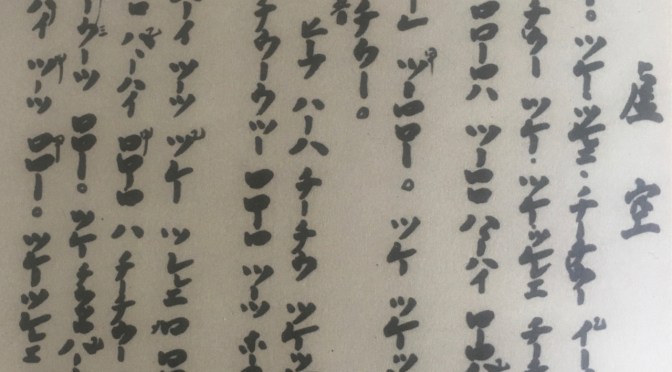
Practicing Kokū 虚空

Kokū is considered one of the oldest compositions for shakuhachi, one of the three fundamental pieces together with Kyorei and Mukaiji.

Koku means “Empty Space,” or “Empty Sky,” (“Ko,” “empty”, and “Ku” “space”, or “sky”.)

There are many legends about this piece, and many different versions. Some versions are based on the story of the “Bell Ringing in an Empty Sky”. It refers to the death of the monk Fuke and his disappearance from his coffin. Only remains the sound of his bell coming from the empty sky. Other legends say that this piece has been composed in the 12th century by the monk Kyochiku, who heard this melody in a mystical dream. With the mist blocking the moon, it looked like the sound of the flute was coming from an empty sky.

Koku has a flavor of infinite mist and echoes. It is said that playing this piece helps one explore the boundaries of “mu” or nothingness, transcending reifications, the artificial cognitive boxes into which we place objects, situations and emotions.

Source: The International Shakuhachi Society

Continue reading Practicing Kokū 虚空

Bosweg October 2017

It has been more than a year I haven’t been to the department of Young People with Dementia (Bosweg) because of a big reorganisation followed by financial cuts. I don’t get paid for these visits but one of the consequences of this reorganisation is that each department must now organise its own activities and I’m attached to another department. So I wasn’t sent there anymore. Luckily, I recently happened to meet someone I already knew from this department and I found my way in again. I was really looking forward to it and to see the patients again. My appointment was today and it turned out to be one of the heaviest visit I made.  Continue reading Bosweg October 2017

The Rhythm of Silence

TakiochiThe Honkyoku pieces (solo traditional pieces written by monks) have no fixed rhythm. The rhythm is based on the length of the breath, the amount of notes you have to play in one breath and how you use your breath. The tradition transmitted from a master gives  indications how to place the tones within a breath. It can vary from a player to the other, but also from one day to the next.
How about silence? Continue reading The Rhythm of Silence

Performances

I’ve been performing since I’m fifteen, and I’ve never learned how to do it. I didn’t even think there was something to learn about it. However, when you think back to how many  people get nervous when they have to perform, from good anxiety to total panic that they have to calm down with medicines or even stronger stuff, you start to ask yourself whether there might be somehow something to learn about it. I can still remember moments of total panic during competitions and it didn’t feel good. Playing music shouldn’t lead to this amount of stress. At a lower level, I also experienced the frustration of practicing so hard for a lesson and then not being able to play the way I wanted when in presence of my teacher and the other students. So, is there something you can do about it?

Continue reading Performances

August 2017

Summer is often a busy period for musicians. Last month, I had some nice performances in festivals and summer school. I’ll get back to them later in other posts. I missed my monthly visit at the dementia care house in July because I was performing abroad. Luckily, I was available to go there in August, last week.

Continue reading August 2017

ESS Summer School 2017

In a few days the annual European Shakuhachi Summer School will begin gathering almost 60 shakuhachi aficionados (teachers and participants) together from all over Europe and with Maekawa Kogetsu as an representation of Myōan and Kinpū ryū. And it all happens in the small provincial town Vejle, Denmark – out in the fringes of Europe. Hurray for celebrating shakuhachi all over Europe! See you there! Kiku Day, Chair of the ESS.

I’m very honoured to be invited to this ESS Summer School where I will teach solo and  group pieces from our Hijiri-kai school. The venue is a boarding school, which will enable us to  blow and spend time together as a group. There will be a lot of different styles represented, traditional and modern music, solo and chamber music, pieces with koto, improvisation and original compositions. It is a great opportunity to listen to a lot of music and meet each other.
Although a big part of the traditional repertoire of shakuhachi consists in solo pieces (honkyoku), blowing together is very important in our school. Fukuda-sensei is tirelessly writing new pieces and arrangements for us when we gather in the Summer Schools organised in France by Daniel Lifermann for La Voie du Bambou. I’m very pleased to share some of his music and the spirit of it this summer in Denmark.
These pieces are meant to be performed by players of all levels, everyone playing according to his capacities. Generally, there isn’t a fixed rhythm except the rhythm of the breath (like in most of the honkyoku music), which allows some fuzziness, like a natural echo or reverberation. Playing together means listening to each other in order to tune in one multiple voice. It’s very good to confront your pitch control with the others’!
Here are the pieces: Continue reading ESS Summer School 2017

Flutes

It’s not always easy to find the right instrument, like to find the right partner for life. Sometimes you have to travel far away.
I started music with the recorder lessons of the primary school and I loved it (while most of my friends didn’t). But at that time, my fascination went to the piano, because of my mother’s LP’s I liked so much to listen to. Piano at home was no option so I ended up learning transverse flute at the local music school. When I was around 15, my godmother showed me that there existed other flutes in the world with bringing me back a flute from Nepal. Couldn’t do much with it but I found it nice with its decorations. Some years later, when I heard a musician playing a kind of transverse flute in Senegal, I went to meet him and bought one of his flute. My collection had started. The sound of this flute still evokes the memory of the land where I was born.


Continue reading Flutes

Summertime

It was very hot when I went to the dementia care house last Tuesday for my monthly visit to the elderly people there. They were sheltering in the shadow and the first group I visited was watching a documentary with pictures of mountains and snow. How refreshing! They weren’t that happy when A. turned off the television and even though I played some music from the north of Japan, it was challenging to pass on to them through my breath a feeling of cool air. Most of them did appreciate my musical interlude though, especially a tiny old woman, Mrs M., cuddling a big cuddle dog she always carries around. She loves music and spontaneously hums along with an evident pleasure. Two people were sleeping and two others were waiting to get the television back, but she was the one who was going to give me the biggest surprise of the day. Continue reading Summertime

Recording yourself

In a previous post, Music recordings, I wrote about the benefits of recording yourself during your practice. Have you tried it so far? How is it working for you? For me, it has really become part of my daily practice. Not that I record myself every day (!) but it has become one of the tools I like to use to practice. Like I use a tuner to control the pitch, a metronome to control the tempo and rhythm, I record myself to check how I sound. Or just to do a run-through.

In addition to my previous post, I’d like to add here a few tips to go further.

Continue reading Recording yourself

Inspiration

April 25 – May 23

Back today to the dementia care home where I’ve been playing for elderly people since 2014. Between today and my last visit on April 25, I gave three very different performances: the Requiem of Jenkins in the concert hall in Middelburg with orchestra, choir and soloist ; the musical show “Fureidesu” with the storyteller Gerard Jellema in Rotterdam, and the opening of the exhibition “Les Petites Peurs” by S.P.A.M. van Griensven also in Rotterdam. Different places, different audiences, different ways of listening, different ways of playing. And here I am today, back in Nijmegen for my monthly visit to the elderly people cuddling their Teddy bears, playing with toys and desperately roaming in the corridors trying to find their way home.

What a difference.

What am I going to play today?

Continue reading Inspiration