

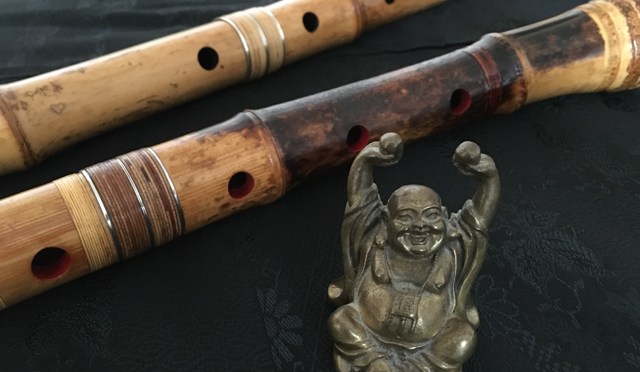
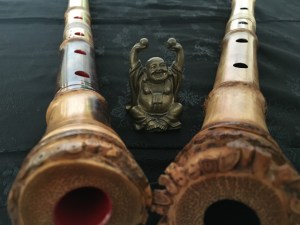
This year, the World Shakuhachi Festival (WSF 2018) will be held in London on 1-4 August, organised by the European Shakuhachi Society (ESS). It’s the first time it will take place in Europa, after Japan, the USA and Australia. I’m very excited to go and take part of this big event. This is my first time at a WSF. There will be shakuhachi players and makers from all around the world, from amateurs and students to top soloists. A lot of different styles will be represented: traditional, folk music (Min’yō), jazz, contemporary, improvisation, and there will be other Japanese instruments (koto, shamisen) as well as Western instruments. Inspiring! We’ll be blowing a lot of sounds 4 days long, during workshops and concerts. A bit overwhelming when you think of it. And quite a challenge for an instrument originally dedicated to meditation, breathing and silence…
Daniel Seisoku Lifermann and myself will be representing the Hijiri School, as our master Fukuda Teruhisa cannot attend the event. It’s the first time that our small school will be officially represented at the WSF, next to the bigger and more famous schools as Kinko-ryū, Kokusai Shakuhachi Kenshukan (KSK) and Tozan-ryū. I’m quite curious to see how it will be perceived. We’ll do our best! Continue reading World Shakuhachi Festival 2018 London




 Hélène Seiyu 聖 優 Shakuhachi