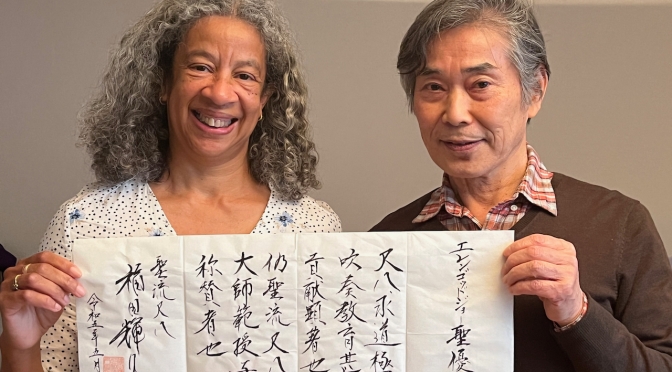
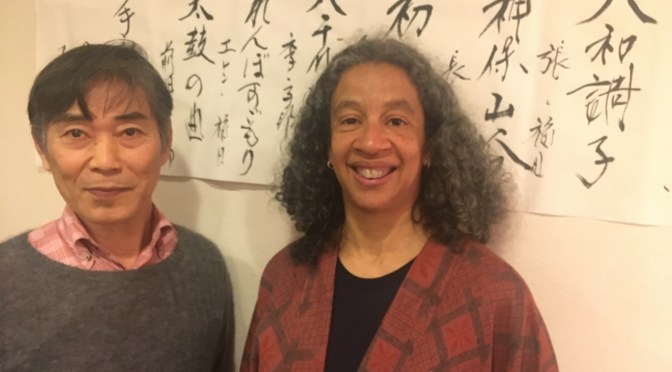
I started my trip in Japan visiting my shakuhachi master Fukuda Teruhisa in Tokyo. We practiced lots of music, including some of his compositions. For each piece, I asked him about the meaning and his intention. At a moment, I asked him if there was any particular order to play a set of pieces and he answered with a story, a Komuso story…
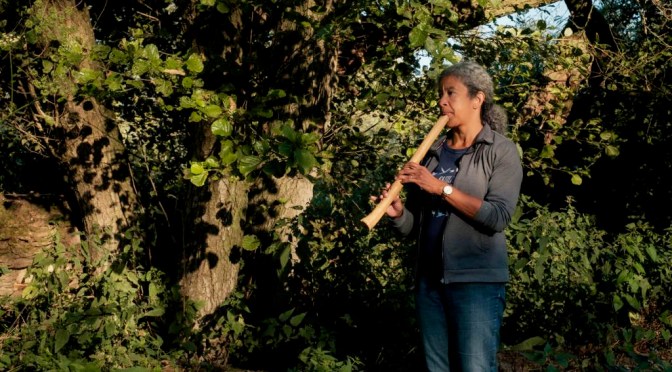
It was very important to me to play in nature during my trip to Japan. There is so much inspiration from nature in traditional honkyoku (solo music for shakuhachi) and in general in Japanese arts and culture, that reading about it was not enough, I wanted to experience it.
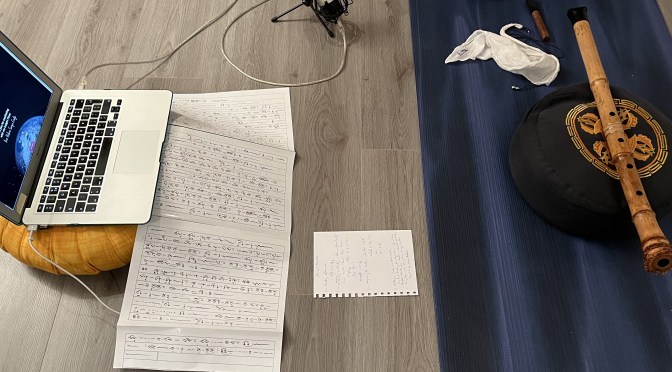
I had selected a few places I absolutely wanted to go to: mountains, bamboo forests, waterfalls. I practiced several pieces I wanted to play there. Playing in nature means obviously playing by heart.
Improvisation was not my goal, as I wanted to experience the connection between specific honkyoku and its environment.
And May was a fantastic month to listen to birds as well!
My short trip of 16 days was way too short to cover all that I wanted to discover, but the experience was very strong and I took back lots of inspiration.
Whenever, wherever, I play those pieces now, there is some of the memory of the Japanese nature in them.
I’d been preparing this trip for months, almost for years. I had dreamt it, imagined, looked up, planed, prepared, organised, booked…
As a result, it went beyond expectations.
The three main aspects of this shakuhachi trip were: 1. Study: studying with my master Fukuda Teruhisa in Tokyo and getting my Dai Shihan diploma (Grand Master) 2. Nature: walking and playing in nature on my own 3. Spirituality: going to different important places for Buddhism and meeting Komuso monks in Nara.
There is so much to say about it that I don’t know where to start!
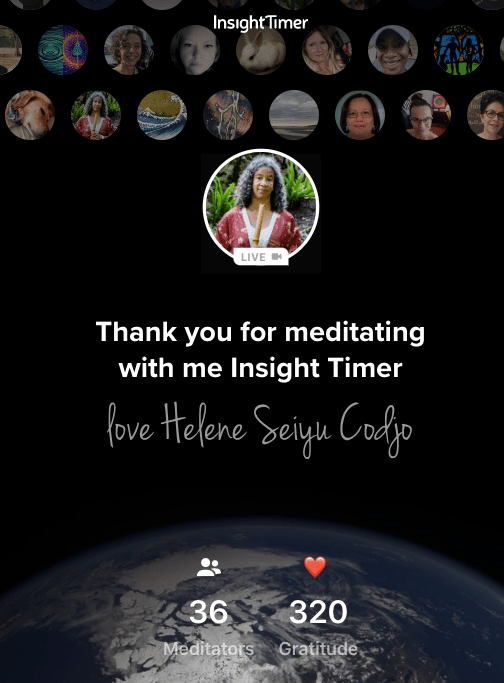
Whenever I give live online meditation sessions on the meditation app Insight Timer, I invite the participants to practice deep breathing meditation with me. I often tell them that if they practice regularly in a safe situation like at home or during the sessions, they will create a habit, a power they can tap in whenever they find themselves in a more challenging situation. The day after my last live session in February and the following weeks, I could experience how right I was!
How can shakuhachi help to go through stressful situations?
Since I started this blog 6 years ago, I’ve published more than 150 posts and pages … only about the Japanese Bamboo flute shakuhachi! Which is not really a popular topic according to Google trends, algorithms and all the bunch of digital numbers rating our lives. But this is my life journey with my shakuhachi flute and I’m happy to share it. I’m even more happy if it inspires others – shakuhachi players, flutists, musicians, non-musicians, anyone.
So what happened on my blog in 2022, according to the analytics? What did you, readers, read and like most? Which of my posts written in 2022 became the most popular?
The Covid-19 pandemic has initiated new activities in my life as a professional shakuhachi player, which is to perform online. I had some resistance at the beginning of the pandemic and it took me time to surrender to the situation… and start performing online.
And now, I’m really liking it. It is very different from physical performances of course and I do miss the direct interaction with the audience, but it feels special to be connected at the same time to people sitting in different places in the world. And there is sometimes even a more personal interaction with the audience through the chat than during a real concert.
This keeps me going. I’m not waiting anymore for the “old situation” to come back, I don’t believe it ever will. So I’m building up with what is possible for me here and now.
So I’m very happy to announce my next online performances!
Did you know that my weekly online meditations, which I started in May 2020 during the Covid-19 pandemic with the purpose of staying connected and blowing together for better health in the world, are still going on?
Every week on Wednesday, we blow shakuhachi and meditate together for 20 to 30 minutes on Zoom (10 to 15 minutes Chakra Meditation and 10 minutes RO-buki.).
During the sessions, the focus goes inwards. You connect to your body, to your inner peace through your breathing and blow with full awareness what your heart tells you (solidarity with the world’s sufferings, healing, compassion, love, emptiness, silence,…), uniting your sounds and efforts with those of the other participants.
“A group of people coming together in a state of presence generate a collective energy field of great intensity.” (Eckhart Tolle)
UPDATE JUNE 2023
After more than three years, the Online Meditations have reached their end. It is no longer possible to join.
In July, my student Christof Zürn, creator of Music Thinking, interviewed me for a podcast about shakuhachi. You can listen to it here .
Earlier this year, we prepared the interview with having an improvisation session in nature, that we recorded. Christof mixed some moments of it in the podcast and I published a short video on my YouTube Channel. We had fun with the geese flowing by, pieces of trees falling on us… We also played Kyorei together. Watch it here:
Shakuhachi belongs to nature
A few days after the podcast was released, I found a very interesting paper about Japanese music, written by Akikazu Nakamura. I already had the deep conviction that honkyoku music takes another dimension when played outside. This paper confirms my experience and gives some very interesting insights about Japanese music, that are important to know in order to improve one’s understanding of playing Japanese music. Here is a short summary and analysis of Nakamura’s paper.








 Hélène Seiyu 聖 優 Shakuhachi