

It has been a while I didn’t go to play for the people with dementia. Before the summer, A., who always accompanies me for the visits, was very ill and the visits were cancelled. In July and August, I was busy abroad. It felt great today to be back to the essential of playing music for me: be part of somebody’s normal daily life, outside of concert halls and music festivals.
I can’t explain how priceless this experience is for me. It is not only a musical experience, but also a spiritual one. It feels like applying meditation, particularly compassion and Tonglen practice, to the patients. Their brains don’t function properly anymore and they are not able to meditate, but while listening to the shakuhachi, I hope they find some peace and quietness of the mind. Continue reading Blue eyes – October 2018
Tag Archives: Honkyoku

福田 輝久 Fukuda Teruhisa’s teaching
This summer, Fukuda Teruhisa 福田 輝久 and his wife Kineya Shiho came to France for a full week of summer school organised by Daniel Seisoku Lifermann and La Voie du Bambou. And following up this week, they came to Rotterdam (The Netherlands), where I teach! I couldn’t be more happy.
I have been following Fukuda Teruhisa’s teaching for more than 12 years now, during 6 intensive weeks in the summer (2006, 2008, 2010, 2013, 2016, 2018), various weekends and masterclasses in between in Paris, and a full week of individual lessons in Tokyo in 2017, and it seems to be no end of what I can learn from him. Each summerschool, when we start with Honte Choshi or Tamuke again, I keep on learning new things, it is amazing. Like it is amazing that he is keeping on making new versions of the scores he already gave us, along with new music he arranged or composed, guiding us deeper and deeper in the details and giving us at the same time more and more knowledge, capacity and freedom to make our own choices. He is a true perfectionist and a highly inspiring teacher and performer.
Continue reading 福田 輝久 Fukuda Teruhisa’s teaching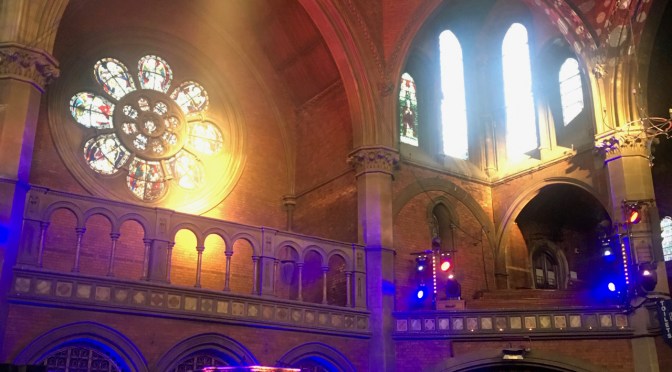
Summer 2018 – WSF London (2)
The World Shakuhachi Festival (WSF) in London was a great place to meet and listen to a lot of different shakuhachi players. On this aspect, it was highly inspiring. Nothing can replace live contact and live sound. Our part-time job at the festival allowed us (Daniel Seisoku Lifermann and me) to devote some time to attend several workshops and lectures, and we took some time in-between to talk to people. I was really happy to see old friends again, meet in real some Facebook friends and make some new friends, even though it was so busy and everything went so fast that it was difficult to go beyond fast contacts. It was really difficult for each teacher to present himself, his style, music and notation in one hour and ten minutes to a bench of students with various backgrounds, knowledge and level. Most of them started with: “I don’t have much time but…”, and somehow, they managed to give an idea of what they wanted to pass on.
As I said before, I couldn’t attend all the workshops and concerts I would have loved to go to. The people I am going to talk about in this post are those I could meet and feel immediately connected to, impressed or inspired by. It is very personal and reflecting my own interests at the moment. They were a lot of great players who were impressive to listen to, and people I just haven’t got the chance to meet this time. So don’t expect an exhaustive list of shakuhachi performers and/or composers here, but just those I particularly hope to stay in contact with, continue to follow their work and inspiration, and hopefully meet again. Continue reading Summer 2018 – WSF London (2)

World Shakuhachi Festival 2018 London
This year, the World Shakuhachi Festival (WSF 2018) will be held in London on 1-4 August, organised by the European Shakuhachi Society (ESS). It’s the first time it will take place in Europa, after Japan, the USA and Australia. I’m very excited to go and take part of this big event. This is my first time at a WSF. There will be shakuhachi players and makers from all around the world, from amateurs and students to top soloists. A lot of different styles will be represented: traditional, folk music (Min’yō), jazz, contemporary, improvisation, and there will be other Japanese instruments (koto, shamisen) as well as Western instruments. Inspiring! We’ll be blowing a lot of sounds 4 days long, during workshops and concerts. A bit overwhelming when you think of it. And quite a challenge for an instrument originally dedicated to meditation, breathing and silence…
Daniel Seisoku Lifermann and myself will be representing the Hijiri School, as our master Fukuda Teruhisa cannot attend the event. It’s the first time that our small school will be officially represented at the WSF, next to the bigger and more famous schools as Kinko-ryū, Kokusai Shakuhachi Kenshukan (KSK) and Tozan-ryū. I’m quite curious to see how it will be perceived. We’ll do our best! Continue reading World Shakuhachi Festival 2018 London

Shakuhachi & Meditation
Happy 2018!
I wish you a healthy, peaceful, musical and happy New Year!
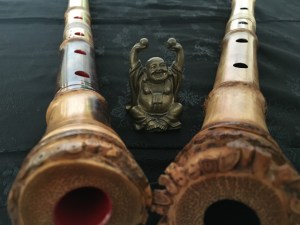
A new year has started, with new challenges and new resolutions. Last year, my good resolutions were to follow 12 zen rules and apply them to shakuhachi. I kept this in mind throughout the year, and started gradually a more consistent practice of meditation. This leads me to my good resolution of this year: be a better person. I believe that everyone can contribute to make this world better starting with oneself, and I’m trying to improve my share. I have been learning a lot since I’m meditating on a daily basis and it has been deepening my shakuhachi practice. Although I’m still a beginner, I’d like to share with you how meditation helps me to become a better shakuhachi player.

Beyond Borders
It has been some time since my last visit to the old people with dementia, which was on the 17th of October. I didn’t think it would take me so long to write a post about this particular day. In the morning, I had just posted my previous post about Practicing Kokū and was planning to write this one quite rapidly afterwards. But life had other plans. Continue reading Beyond Borders
Practicing Kokū 虚空
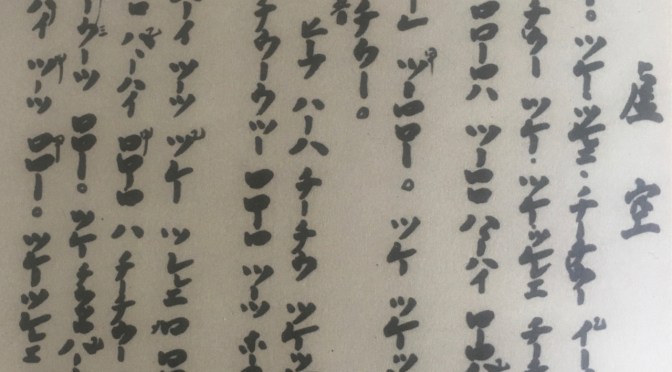
Kokū is considered one of the oldest compositions for shakuhachi, one of the three fundamental pieces together with Kyorei and Mukaiji.
Koku means “Empty Space,” or “Empty Sky,” (“Ko,” “empty”, and “Ku” “space”, or “sky”.)
There are many legends about this piece, and many different versions. Some versions are based on the story of the “Bell Ringing in an Empty Sky”. It refers to the death of the monk Fuke and his disappearance from his coffin. Only remains the sound of his bell coming from the empty sky. Other legends say that this piece has been composed in the 12th century by the monk Kyochiku, who heard this melody in a mystical dream. With the mist blocking the moon, it looked like the sound of the flute was coming from an empty sky.
Koku has a flavor of infinite mist and echoes. It is said that playing this piece helps one explore the boundaries of “mu” or nothingness, transcending reifications, the artificial cognitive boxes into which we place objects, situations and emotions.
Source: The International Shakuhachi Society

Bosweg October 2017
It has been more than a year I haven’t been to the department of Young People with Dementia (Bosweg) because of a big reorganisation followed by financial cuts. I don’t get paid for these visits but one of the consequences of this reorganisation is that each department must now organise its own activities and I’m attached to another department. So I wasn’t sent there anymore. Luckily, I recently happened to meet someone I already knew from this department and I found my way in again. I was really looking forward to it and to see the patients again. My appointment was today and it turned out to be one of the heaviest visit I made. Continue reading Bosweg October 2017

The Rhythm of Silence
 The Honkyoku pieces (solo traditional pieces written by monks) have no fixed rhythm. The rhythm is based on the length of the breath, the amount of notes you have to play in one breath and how you use your breath. The tradition transmitted from a master gives indications how to place the tones within a breath. It can vary from a player to the other, but also from one day to the next.
How about silence? Continue reading The Rhythm of Silence
Performances
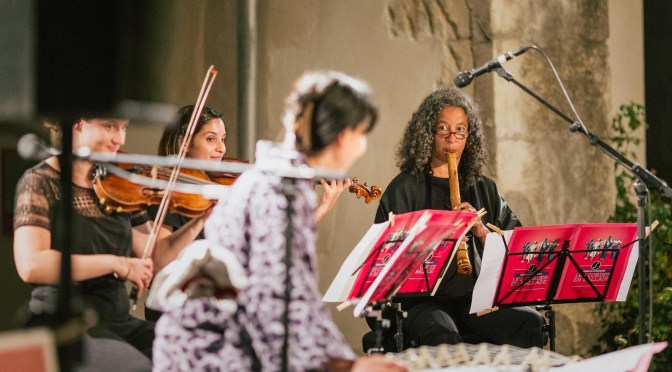
I’ve been performing since I’m fifteen, and I’ve never learned how to do it. I didn’t even think there was something to learn about it. However, when you think back to how many people get nervous when they have to perform, from good anxiety to total panic that they have to calm down with medicines or even stronger stuff, you start to ask yourself whether there might be somehow something to learn about it. I can still remember moments of total panic during competitions and it didn’t feel good. Playing music shouldn’t lead to this amount of stress. At a lower level, I also experienced the frustration of practicing so hard for a lesson and then not being able to play the way I wanted when in presence of my teacher and the other students. So, is there something you can do about it?
 Hélène Seiyu 聖 優 Shakuhachi