Waterlelie, January 2017

I’m coming again, first time after the Christmas holidays. It’s a sunny and very cold day outside. Inside it’s very warm as ever. You don’t really feel the seasons here, it’s always very warm.

Going to the closed world of people stuck in their minds. Front door with security, first door with code, corridors, second door with code, corridors, turn right, turn left, here I am.

The first person we visit is Mrs Kisses. I give her this nickname because when she’s enjoying something, she grabs your hand to kiss it. Last time I was in her bedroom, it was her birthday, I think she turned 90 but I’m not sure anymore. I remember I hesitated to play a birthday song but I finally didn’t. She looks at us, not really reacting. And then she sees the flute, her eyes light up, and she points her finger to it with a big smile. And she starts to kiss A.’s hands.

When I started to play for people with dementia almost 3 years ago, I was told they won’t recognise me even if I was coming every day. From the beginning, I could notice that, although they most likely didn’t remember me, some of them did recognise the shakuhachi. Each time this happens, it gives me a warm feeling. Continue reading Waterlelie, January 2017

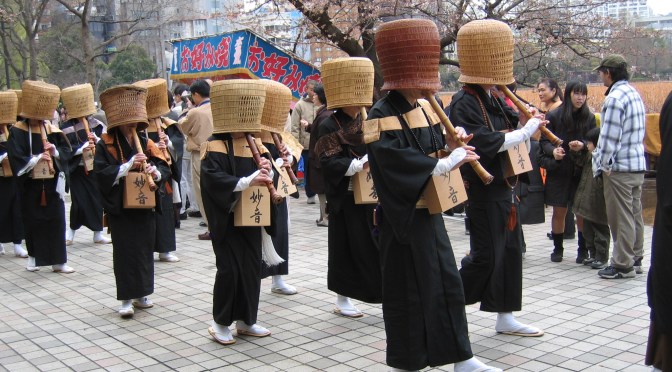
Komuso monks in Tokyo, April 2005

My first day in Japan, my first day in Tokyo… I didn’t know where to go so I decided to go to a park. Seeking nature in such a big city instead of running to see temples, modern buildings, palaces, shops, museums… that’s me…

At that time, I knew very little about the shakuhachi. I had one, I had taken a few lessons but I wasn’t getting much further than playing the basic notes and a few simple melodies. I had taken my shakuhachi in my suitcase -“to play in the metro” said ironically to me a musician of our orchestra- to see if I would get more inspired to play it in Japan. It’s not that I missed inspiration or desire to play it, no at the time I missed time to think and make a decision. Actually I took this time just before going to Japan, but was not conscious yet that shakuhachi was part of the choices I would have to make in my life. Continue reading Komuso monks in Tokyo, April 2005

Ro-buki

“If you have only five minutes in your day to practice your shakuhachi, play RO” (Fukuda Teruhisa).

Otsu-no-RO is the lowest note on the shakuhachi, all holes are closed. Practicing RO is very good your for your breath and embouchure control, and also to concentrate on the way you hold your  flute. It’s a good exercise to be aware of the tensions of your body and try to remove them, and find the just balance between relaxation and keeping the proper shape of the sound. It is recommended to blow RO at least 5 minutes, up to 10 minutes and it can be part of your daily meditation with shakuhachi practice.
Longer is of course possible, as long as you stay concentrated and don’t cramp. Blowing Kan-no-RO is also an interesting alternative I’ll develop later.

I found a few months ago on the website of Alcvin Ryuzen Ramos some very interesting variations to the practice of RO-buki. They give the possibility to train a large range of sounds while practicing only one tone… a shakuhachi achievement… Here are his tips, combining blowing and dynamics training:

Continue reading Ro-buki

Daily meditation with the shakuhachi

Meditation with shakuhachi is different than practicing or performing. There is no artistic goal. It is full concentration and full acceptation, without judgement. I have a few standard exercises to get started, and, depending on the days, I like to experiment and try new things. I generally put on a timer and decide how long I’m going to practice.

Continue reading Daily meditation with the shakuhachi

Good resolutions

My good resolutions for 2016 were these 12 zen-rules I found somewhere on the web (my apologies to the author, I don’t know anymore where I read them).

Zen – 12 essential rules

  1. Do one thing at a time
  2. Do it slowly and deliberately
  3. Do it completely
  4. Do less
  5. Put space between things
  6. Develop rituals
  7. Designate time for certain things
  8. Devote time to sitting
  9. Smile and serve others
  10. Make cleaning and cooking become meditation
  11. Think about what is necessary
  12. Live simply

I had the feeling that they could help me to improve things in my life. One year later, reading them again, I can see what I already managed to improve and where I still need to work on.

I can apply some of them pretty well to the shakuhachi: Nr.1-2-3-5-6-8 are easily related to the way I use the shakuhachi to meditate (read here how).
Nr 5, “put space between things“, makes me think of the Japanese “ma“. In daily life, it also means for me “take a break regularly”.

But I still have a long way to go, so my good resolutions for 2017 remain these 12 rules, with emphasis on Nr.4 “do less” and Nr.11 “think about what is necessary“, with the help of Nr.5 again (“put space between things“) and Nr.7 “designate time for certain things“. Actually, they are all about making choices… apparently, that’s what I need for this new year.

For Nr.10, I think I manage pretty well with cooking as a meditation moment, but I still have to work hard on the cleaning!

To be continued…


Happy 2017!

One week of holidays and we are one year further… 2017!! The time of good wishes and resolutions has come. I send you my best wishes for a year of peace, good health, success and happiness. I wish that these wishes become daily wishes, not only for the beginning of January but for the entire year long. I wish that we every day try our best to bring more peace to our world and life, to listen better to the others and try to understand each other better, to find inner peace and happiness with changing bad habits, and that we trust we can do it and don’t give up when difficulties appear.

What you do today can improve all your tomorrows (Ralph Marston)

Happy New Year!

Christmas Spirit

I grew up in a catholic family and although I’m no believer myself, Christmas has always been for me an important symbol of peace and reconciliation. As a child, my favourite Christmas songs were those of The Poppys, a group of French children singing about love, world peace, and against war. I hadn’t listened to these songs for years, but they still move me while listening to them again so many years later, because there’re performed with all the faith and sincerity of children’ hearts, the very same feelings I had in my own child’s heart.
Continue reading Christmas Spirit

Are there Japanese women playing shakuhachi?

I got this question from one of my (male) students during a workshop mainly attended by men. I couldn’t answer, as I actually don’t know any Japanese female shakuhachi player. All the Japanese masters I know are men. I do know some Western female professional shakuhachi players, but we’re not a lot, so the question is still open.

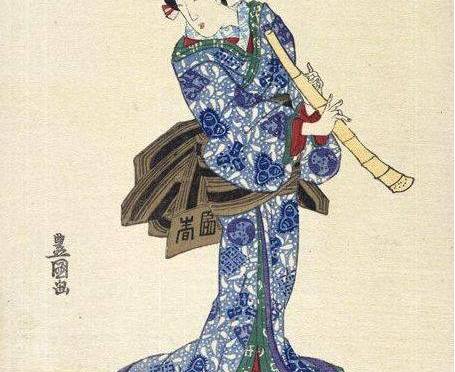
I recently heard of a book researching the history of shakuhachi through old pictures and paintings. This gave me the idea to do a little research myself. Here are some Ukiyo-e I found on the web, depicting women playing the shakuhachi, during the Edo period (17th-19th century). I’m now even more curious to know about these women playing shakuhachi at that time…


Update on May 9, 2019: Here is a link to a paper discussing this question.

5 good reasons to take lessons from a certified teacher

5 good reasons to take lessons from a certified teacher

  1. You will play at the proper pitch and don’t sound a semitone lower, blaming it on the flute.
  2. You will learn the specific techniques which make it unique.
  3. You will learn the traditional repertoire which is exclusively transmitted from master to student.
  4. You will meet fellow students, share your experience and play together.
  5. You will make progress.

6 good reasons to learn shakuhachi

6 good reasons to learn shakuhachi

1. It is a very special instrument: its sounds is unique and will open a new world for you.

2. It is a deep breathing training: bringing your awareness to your breath is relaxing and a deep breathing training is very good for your health. It will help you find a quiet moment for yourself.

3. It is a challenging instrument:

  • physically: to get a sound, to keep it, to get the proper pitch.
  • mentally: to go on and don’t give up because it’s more difficult than what you thought. You can do it.
  • energetically: it’s a mirror of your energy level, and it will help you to improve it.
  • spiritually: you’ll have to let go of your self and accept what is given by the flute. Playing the old traditional music is a spiritual act.

4. It is a very old tradition, which reaches people deeply.

5. It will improve your concentration in your daily life.

6. It will bring peace in your life. And you’ll be able to share this peace with the people around you by playing shakuhachi for them.

Hélène Seiyu Codjo