Tag Archives: Japanese traditional music

World Shakuhachi Festival 2018 London

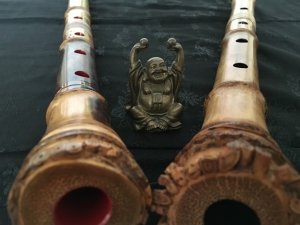
This year, the World Shakuhachi Festival (WSF 2018) will be held in London on 1-4 August, organised by the European Shakuhachi Society (ESS). It’s the first time it will take place in Europa, after Japan, the USA and Australia. I’m very excited to go and take part of this big event. This is my first time at a WSF. There will be shakuhachi players and makers from all around the world, from amateurs and students to top soloists. A lot of different styles will be represented: traditional, folk music (Min’yō), jazz, contemporary, improvisation, and there will be other Japanese instruments (koto, shamisen) as well as Western instruments. Inspiring! We’ll be blowing a lot of sounds 4 days long, during workshops and concerts. A bit overwhelming when you think of it. And quite a challenge for an instrument originally dedicated to meditation, breathing and silence…

Daniel Seisoku Lifermann and myself will be representing the Hijiri School, as our master Fukuda Teruhisa cannot attend the event. It’s the first time that our small school will be officially represented at the WSF, next to the bigger and more famous schools as Kinko-ryū, Kokusai Shakuhachi Kenshukan (KSK) and Tozan-ryū. I’m quite curious to see how it will be perceived. We’ll do our best! Continue reading World Shakuhachi Festival 2018 London

Playing again at the Bosweg

Since October, I have been playing shakuhachi three times at the Bosweg. I must confess I was a bit nervous the first time after October: would it be so hectic again? But actually, during these three sessions in February, March and May, the patients were very quiet. February was particularly nice, because the nurses were also very enthusiastic. Which was not entirely the case when I went again this week. What happened? Continue reading Playing again at the Bosweg

CD “Japan: Musical Offering” – Fukuda Teruhisa

In January 2018, the new CD of Fukuda Teruhisa has been released. I was waiting for this CD to come out since I heard his concert in November 2015 in Genève (Switzerland) and was totally mesmerised by it. So, of course, this post is not an objective review, but just some personal impressions I’d like to share.

Fukuda Teruhisa is well known for his interpretations of contemporary music. He recorded several CD of it. As for the traditional repertoire, his discography features a solo CD of “Kinko-ryū pieces” and a Sankyoku CD “Music of the Edo period” (trio with koto and shamisen). But this is the first CD where he only plays Koten honkyoku, meaning very old traditional music. Continue reading CD “Japan: Musical Offering” – Fukuda Teruhisa

Light and shadow

January 2018

After the Christmas holidays, when I went back to the dementia care house where I monthly play shakuhachi for the patients, A. told me that the departments had been closed for almost a month because of the Norovirus. Most of the patients were still weak and laid in bed. We had a relatively short session, nice though. I especially remember playing for P., a cheerful man who used to play piano and loves listening to music. He couldn’t get enough of it. One of the women was also very happy we came. It was as if she remembered me from the previous visit in November because she was immediately more receptive to the music. I find it so touching when the patients, although weak, strengthless or having trouble to control their movements, do their best to express their pleasure with giving me an applaus. I love to see a smile on their faces or in their eyes.

Continue reading Light and shadow

Shakuhachi & Meditation

Happy 2018!

I wish you a healthy, peaceful, musical and happy New Year!

A new year has started, with new challenges and new resolutions. Last year, my good resolutions were to follow 12 zen rules and  apply them to shakuhachi. I kept this in mind throughout the year, and started gradually a more consistent practice of meditation. This leads me to my good resolution of this year: be a better person. I believe that everyone can contribute to make this world better starting with oneself, and I’m trying to improve my share. I have been learning a lot since I’m meditating on a daily basis and it has been deepening my shakuhachi practice. Although I’m still a beginner, I’d like to share with you how meditation helps me to become a better shakuhachi player.

img_0666


Continue reading Shakuhachi & Meditation

One year!

I can’t believe it’s already one year I’ve been writing this blog. When I started it, I had no idea I would like it so much. I didn’t have much expectations, just wanted to try and see.  One year later, I’d like to thank all my readers for their support, nice comments, reading, listening. If you like my music and stories, please don’t hesitate to follow me by entering your e-mail address on the website. You’ll receive my posts as soon as they are published. Please also check regularly the pages, I post new music there from time to time.

Keep on reading, I have a little surprise for you today…

Continue reading One year!

Great feelings

In most of my visits to the dementia care house, I notice how the condition of the patients has deteriorated. Their illness can’t be cured and it can only go worse and worse. As I play in less departments since last year, I see the same patients more often. And I notice that writing this blog helps me to better remember them and what happened during my visits. After my last visit last week, I was very happy but couldn’t say why. Wait a minute, it’s because something very special happened: improvement!

Continue reading Great feelings

Beyond Borders

It has been some time since my last visit to the old people with dementia, which was on the 17th of October. I didn’t think it would take me so long to write a post about this particular day. In the morning, I had just posted my previous post about Practicing Kokū and was planning to write this one quite rapidly afterwards. But life had other plans. Continue reading Beyond Borders

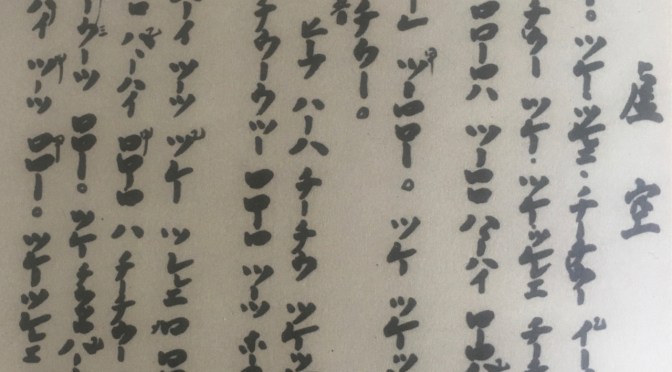
Practicing Kokū 虚空

Kokū is considered one of the oldest compositions for shakuhachi, one of the three fundamental pieces together with Kyorei and Mukaiji.

Koku means “Empty Space,” or “Empty Sky,” (“Ko,” “empty”, and “Ku” “space”, or “sky”.)

There are many legends about this piece, and many different versions. Some versions are based on the story of the “Bell Ringing in an Empty Sky”. It refers to the death of the monk Fuke and his disappearance from his coffin. Only remains the sound of his bell coming from the empty sky. Other legends say that this piece has been composed in the 12th century by the monk Kyochiku, who heard this melody in a mystical dream. With the mist blocking the moon, it looked like the sound of the flute was coming from an empty sky.

Koku has a flavor of infinite mist and echoes. It is said that playing this piece helps one explore the boundaries of “mu” or nothingness, transcending reifications, the artificial cognitive boxes into which we place objects, situations and emotions.

Source: The International Shakuhachi Society

Continue reading Practicing Kokū 虚空

Bosweg October 2017

It has been more than a year I haven’t been to the department of Young People with Dementia (Bosweg) because of a big reorganisation followed by financial cuts. I don’t get paid for these visits but one of the consequences of this reorganisation is that each department must now organise its own activities and I’m attached to another department. So I wasn’t sent there anymore. Luckily, I recently happened to meet someone I already knew from this department and I found my way in again. I was really looking forward to it and to see the patients again. My appointment was today and it turned out to be one of the heaviest visit I made.  Continue reading Bosweg October 2017