Category Archives: Shakuhachi practice

Effective Tips for Memorising Shakuhachi Honkyoku

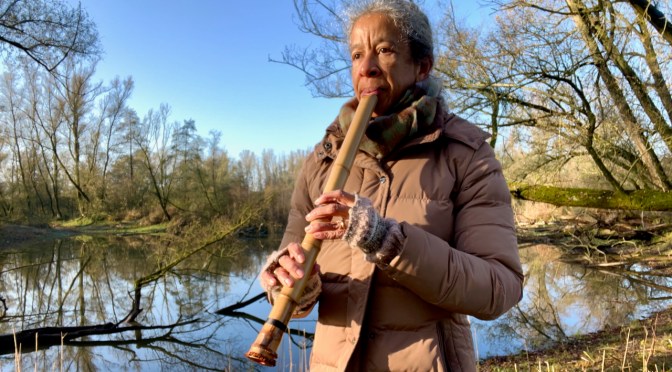
When I started playing in nature a few years ago, I quickly realised that I needed to learn my Honkyoku repertoire by heart. I wanted to be able to play anywhere, without relying on notation.

And then I made a huge discovery.

Why play Honkyoku by heart?

I wrote about this topic a few years ago (in this post), and looking back, I’m still using the same approach—only now, my repertoire has grown a lot.

Oral transmission

Traditional shakuhachi music is an oral tradition. Notation came later, mainly as a tool to remember and pass on the music. But you cannot truly play Honkyoku as it is meant to sound if you don’t know the style or have never heard it.

That’s why I make so many practice recordings for my students. You can find them on my SoundCloud page.

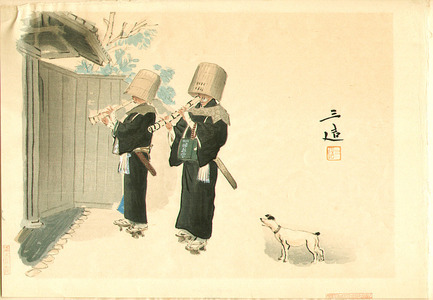
Playing by heart connects you more deeply to this tradition—and to yourself. Your listening shifts. You begin to follow in the footsteps of the Komusō monks.

Reading notation feels, to me, like a very Western approach, similar to classical music. Have you ever seen African drum players reading notation? Their rhythmic polyphony is incredibly complex and precise, yet learned without sheet music. This is just one example, but if you look at traditional music from around the world, you’ll notice how rarely musicians perform with written scores.

Benefits of playing Honkyoku by heart

Focus

The first benefit is that I can dedicate much more attention to listening: to my breath, to the quality of the sound, to expression, and to the silence between phrases.

Repertoire

The more I play outdoors, the more my repertoire grows. I just pick up my shakuhachi and play my favourite pieces—no paper, no digital notation, no music stand needed.

Confidence

The more confident I become playing by heart in nature, the more confident I feel performing by heart in concert halls too.
In concerts in Europe and International Festivals, and even at the World Shakuhachi Festival in Texas, I performed by heart.

I often prepare for my performances in nature—like I did in Texas.

Even when I use notation, learning the piece by heart first gives me a deeper understanding of it and more room for expression.

Students’ feedback

I encourage my students to play by heart as well. Their feedback is always positive and valuable.

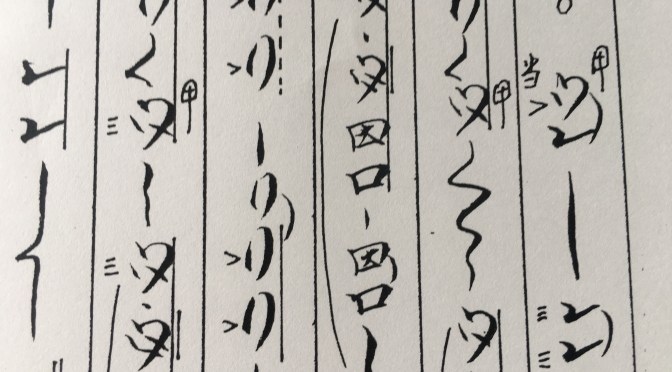
Last week, during a workshop, six of them performed by heart for the group. It was challenging, but magical to hear how each of them dared to express themselves through the music (the notations you see in the photos are from the group piece we were studying during the workshop; they are not the pieces the students performed for the group.)

Of course, part of the attention goes into avoiding mistakes, and that can create tension. But the same happens when reading a score. Learning by heart brings you a step deeper into the music.

Why is it difficult to learn Honkyoku by heart?

Koten Honkyoku is not particularly melodic or rhythmic—not something you can sing easily like a song (although singing the phrases can help with phrasing).

The music is built on patterns, sound colours, and breath length.
Many patterns reappear across different pieces, sometimes with small variations. This makes it easy to mix pieces—starting one and ending with another! Practice helps reduce this.

Learning by heart will help you understand the music better and eventually make it your own.

Tips for Learning by Heart

1. The First Steps

  • Study the piece thoroughly (with notation and recordings) until you can play it smoothly without hesitation.
  • Look at the title: what is the piece about?
  • Unfold the structure: where are the main sections? How do they transition?
  • Build your own “story.” Not necessarily a literal story—just something that makes the phrases and sections feel logical rather than random.

The Next Steps

  • Start with a short piece you know well.
  • Play a phrase while looking at the notation, then repeat it with your eyes closed.
  • Do the same with whole sections.
  • Always know exactly where you are. Whether you’re a visual or auditory learner, don’t rely only on the logical flow. Have your internal “GPS” ready for when you lose your place.
    => Practice starting from different points—not just the beginning. You should be able to start anywhere and play to the end.
  • Learn from your mistakes:
    – Why do they happen in a specific spot?
    – Is it random, or does it happen often?
    – What’s unclear in that phrase?
  • Record yourself and listen back with the notation. Fix inaccuracies.
  • Play along with a recording and notice when you diverge.
  • Go into nature and try again and again!

30-Minute Playing-by-Heart Challenge

I’m currently training my memory by starting each day with 30 minutes of Honkyoku played by heart.

Some pieces need refreshing, and I’m gradually adding new and longer ones.

Will you join the challenge?
Start with just 5 minutes a day and increase gradually.

I’d love to hear from you!

From the Heart

On March 2, 2025, I’ll be giving a free online workshop organised by the European Shakuhachi Society. Click here for information and registration.

If you are interested, please register even if you cannot attend the event live. You’ll get the teaching material and a link to watch it back afterwards.

From the Heart

The theme of the workshop is From the Heart. I’ll be teaching Nyoi Chōshi, which is a short prelude to a longer piece, Nyoi, composed by Miyakawa Nyozan at the end of the 19th century.

The level is beginner/elementary but the workshop will also be interesting for more advanced students. Going back to the basics is always good!

Playing a simple piece allows for more precision to pitch, ornementation, phrasing, tone quality, etc. The beginners’ version will allow participants to learn the main line and enjoy its simplicity (simple doesn’t mean easy!).

We will also work to embody the piece so that you can make it your own.

You learn honkyoku from notation but you play it from the heart.

Continue reading From the Heart

Shakuhachi Blog – 6 years!!

Since I started this blog 6 years ago, I’ve published more than 150 posts and pages … only about the Japanese Bamboo flute shakuhachi! Which is not really a popular topic according to Google trends, algorithms and all the bunch of digital numbers rating our lives. But this is my life journey with my shakuhachi flute and I’m happy to share it. I’m even more happy if it inspires others – shakuhachi players, flutists, musicians, non-musicians, anyone.

So what happened on my blog in 2022, according to the analytics? What did you, readers, read and like most? Which of my posts written in 2022 became the most popular?

Continue reading Shakuhachi Blog – 6 years!!

6 Shakuhachi Practice Tips for Busy People

When you have little time to practice shakuhachi, what should you do to make progress and be happy with your practice?

Here are some tips to help you. Let me know which one you find the most useful!

Continue reading 6 Shakuhachi Practice Tips for Busy People

Deep Breathing Meditation

What is your relationship with your breathing? Do you ignore it, train it, observe it?… Has the Covid-19 pandemic affected your awareness about your breathing in any way?

Blowing the shakuhachi is a deep breathing training. Over the years, I notice that my breathing’s awareness and quality have improved, and as a result, the connection with my breathing has increased my inner peace, my ability to manage my emotions, and more generally, my feeling of happiness.

Since February 2022, I give live meditation sessions of the app Insight Timer. I share with the participants the deep breathing meditation training in relation to the musical tradition of shakuhachi, which combines the unique sounds of the flute with inspiring music.
Being connected with people from all over the world at the same time is really special.

These sessions are FREE, so don’t hesitate to follow me and attend my sessions!

You can also train by yourself anytime, listening to my audio meditations on the app. Keep reading to discover how.

Subscribe to my blog here and don’t miss any post:

Continue reading Deep Breathing Meditation

How to play “Kan”?!?!?

Why is the upper register Kan so difficult for many of us?

When I started learning shakuhachi, I was already a professional flutist, and still, as a beginner shakuhachi student, I found that the Kan register was a bit challenging, especially the two higher notes (Hi and I). There was something there that took me a bit more time to feel and master. Although the lips technique is quite similar to the flute’s technique, I needed to find some adjustments. What was going on?

Continue reading How to play “Kan”?!?!?

Tutorial Videos

When I opened my Virtual Shakuhachi Dojo on Patreon last February (https://www.patreon.com/shakudojo), I started to film tutorial videos for the patrons of the KAN Tier. Once a month, I address a specific topic or technique. So far I have published videos about abdominal breathing, embouchure for (absolute) beginners, the basic scale otsu, how to play in kan, how to attack a sound, how to warm up, meditation in nature. When you subscribe, you also get access to a PDF-file with basic exercises for practicing long tones, fingers, octaves and intervals. In the coming months, I’ll be filming how to practice these exercises and release the videos in my Dojo.

Why do you have to pay to get access to this content?

Continue reading Tutorial Videos

Shakuhachi by Heart

The two last months I have been quite busy recording videos in the nature (read previous blog post about it here). It started a bit out of frustration: concert halls desperately closed for so long, impossibility to make plans to work in the short run, living on the hope that it would get better after the summer when most people got vaccinated to start to perform again,… But hope is not enough and I couldn’t just stay put and wait for the situation to improve. The current pandemic has given me the opportunity to challenge myself to find other ways to create and still go on, like creating a virtual Dojo on Patreon (visit it here).

Outside my confort zone

Some artists in bigger structures and/or better network manage to organise live streams, I don’t. Luckily I love birds and birdsongs. Playing and recording in nature turned out to be a very nice activity yet challenging. It means playing in the cold, in the dark, in the rain, in the mud, in the wind, without the supportive acoustic of a concert hall or any amplification… It means going out of my comfort zone and letting go of my blockages. It means playing by heart.
But it also means being surrounded by birdsongs, enjoying space, deep inner peace, being present to everything happening. This is so rewarding!

In this post, I’ll describe how I pushed my limits and I’ll give some tips to play by heart.

Playing by heart is a path to meditation.

Continue reading Shakuhachi by Heart

Practice Practice Practice

The student: -I don’t make any progress. How can I make progress?
Me: -Practice.
The student: -But I practiced!
Me: -What did you practice exactly?
And how?

Most of the times it turned out that the student didn’t practice that much after all. Or not WHAT I asked him/her to practice. Or not HOW I asked him/her to practice. Why? I wonder. Maybe is it not that obvious for everyone what practicing means?

So here are some thoughts about practicing shakuhachi. And about practicing in general, not only for shakuhachi. I am an amateur photographer and once I asked a friend who is a professional photographer how I could improve my photos and she answered “Practice this and that”. So practice practice practice. Meaningfully.

Even if you think that you know what practicing is, please read this post further. I’ll be happy to hear if it matches what you already know and/or if you have some more tips to share.

Continue reading Practice Practice Practice

Invitation to my virtual Shakuhachi Dojo!

In the Netherlands we entered 2021 in full lockdown. No fireworks, no party. With the hope that the world situation will improve dramatically in 2021 with vaccination, I started to dream more and more of a virtual space to develop my activities and connect with more people. This dream has become a virtual shakuhachi dojo on Patreon! Discover it here.

What it is exactly ?

It is a space where I will share every month the different aspects of my work with shakuhachi: recordings, meditations, tutorial videos and creations. Choose your abonnement and you will receive monthly benefits and exclusive contents. If I get enough Patrons, it will help me to realise some of my dreams!!

When you realise that the ultimate happiness is being yourself and that nobody can be better than you at it, then the competitive ego disappears. Remains the deep motivation to do your best at being yourself, for you and for the world. This is what this project is about.

Continue reading Invitation to my virtual Shakuhachi Dojo!