One year!

I can’t believe it’s already one year I’ve been writing this blog. When I started it, I had no idea I would like it so much. I didn’t have much expectations, just wanted to try and see.  One year later, I’d like to thank all my readers for their support, nice comments, reading, listening. If you like my music and stories, please don’t hesitate to follow me by entering your e-mail address on the website. You’ll receive my posts as soon as they are published. Please also check regularly the pages, I post new music there from time to time.

Keep on reading, I have a little surprise for you today…

Continue reading One year!

Great feelings

In most of my visits to the dementia care house, I notice how the condition of the patients has deteriorated. Their illness can’t be cured and it can only go worse and worse. As I play in less departments since last year, I see the same patients more often. And I notice that writing this blog helps me to better remember them and what happened during my visits. After my last visit last week, I was very happy but couldn’t say why. Wait a minute, it’s because something very special happened: improvement!

Continue reading Great feelings

Beyond Borders

It has been some time since my last visit to the old people with dementia, which was on the 17th of October. I didn’t think it would take me so long to write a post about this particular day. In the morning, I had just posted my previous post about Practicing Kokū and was planning to write this one quite rapidly afterwards. But life had other plans. Continue reading Beyond Borders

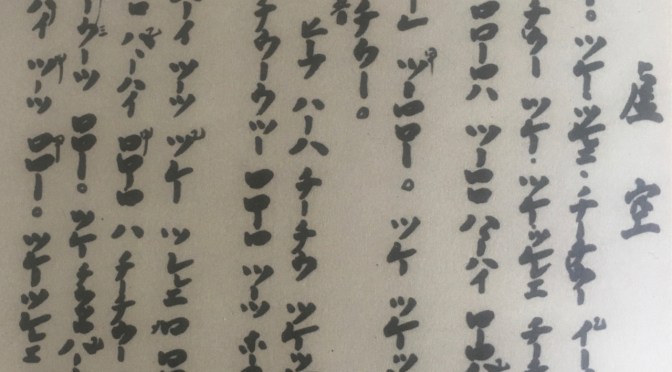
Practicing Kokū 虚空

Kokū is considered one of the oldest compositions for shakuhachi, one of the three fundamental pieces together with Kyorei and Mukaiji.

Koku means “Empty Space,” or “Empty Sky,” (“Ko,” “empty”, and “Ku” “space”, or “sky”.)

There are many legends about this piece, and many different versions. Some versions are based on the story of the “Bell Ringing in an Empty Sky”. It refers to the death of the monk Fuke and his disappearance from his coffin. Only remains the sound of his bell coming from the empty sky. Other legends say that this piece has been composed in the 12th century by the monk Kyochiku, who heard this melody in a mystical dream. With the mist blocking the moon, it looked like the sound of the flute was coming from an empty sky.

Koku has a flavor of infinite mist and echoes. It is said that playing this piece helps one explore the boundaries of “mu” or nothingness, transcending reifications, the artificial cognitive boxes into which we place objects, situations and emotions.

Source: The International Shakuhachi Society

Continue reading Practicing Kokū 虚空

Bosweg October 2017

It has been more than a year I haven’t been to the department of Young People with Dementia (Bosweg) because of a big reorganisation followed by financial cuts. I don’t get paid for these visits but one of the consequences of this reorganisation is that each department must now organise its own activities and I’m attached to another department. So I wasn’t sent there anymore. Luckily, I recently happened to meet someone I already knew from this department and I found my way in again. I was really looking forward to it and to see the patients again. My appointment was today and it turned out to be one of the heaviest visit I made.  Continue reading Bosweg October 2017

The Rhythm of Silence

TakiochiThe Honkyoku pieces (solo traditional pieces written by monks) have no fixed rhythm. The rhythm is based on the length of the breath, the amount of notes you have to play in one breath and how you use your breath. The tradition transmitted from a master gives  indications how to place the tones within a breath. It can vary from a player to the other, but also from one day to the next.
How about silence? Continue reading The Rhythm of Silence

September 2017

My last visit to the dementia care house was nice again. It sounds quite repetitive if you’ve read my other posts about my visits, although it is each time different. I never know what is going to happen and I am always a little bit nervous what to expect. How can you prepare yourself to the unexpected?

Last time, I was in a busy period, I was tired, I wanted things to get done, and there I stand, waiting for A. to finish an endless conversation with people of the department, starting to get annoyed, thinking “this has nothing to do with me, I have so many other things to do”. And then I take my flute out of my bag and start to play to warm up, which I normally never do because I don’t need to, but today I do. It is not to warm up the flute, it is for me to calm down, to open my heart and be ready to meet the patients. And it works. A few breaths and my stress is gone, the outside world can wait, I’m happy to be here, I’m ready.

Continue reading September 2017

Performances

I’ve been performing since I’m fifteen, and I’ve never learned how to do it. I didn’t even think there was something to learn about it. However, when you think back to how many  people get nervous when they have to perform, from good anxiety to total panic that they have to calm down with medicines or even stronger stuff, you start to ask yourself whether there might be somehow something to learn about it. I can still remember moments of total panic during competitions and it didn’t feel good. Playing music shouldn’t lead to this amount of stress. At a lower level, I also experienced the frustration of practicing so hard for a lesson and then not being able to play the way I wanted when in presence of my teacher and the other students. So, is there something you can do about it?

Continue reading Performances

August 2017

Summer is often a busy period for musicians. Last month, I had some nice performances in festivals and summer school. I’ll get back to them later in other posts. I missed my monthly visit at the dementia care house in July because I was performing abroad. Luckily, I was available to go there in August, last week.

Continue reading August 2017

ESS Summer School 2017

In a few days the annual European Shakuhachi Summer School will begin gathering almost 60 shakuhachi aficionados (teachers and participants) together from all over Europe and with Maekawa Kogetsu as an representation of Myōan and Kinpū ryū. And it all happens in the small provincial town Vejle, Denmark – out in the fringes of Europe. Hurray for celebrating shakuhachi all over Europe! See you there! Kiku Day, Chair of the ESS.

I’m very honoured to be invited to this ESS Summer School where I will teach solo and  group pieces from our Hijiri-kai school. The venue is a boarding school, which will enable us to  blow and spend time together as a group. There will be a lot of different styles represented, traditional and modern music, solo and chamber music, pieces with koto, improvisation and original compositions. It is a great opportunity to listen to a lot of music and meet each other.
Although a big part of the traditional repertoire of shakuhachi consists in solo pieces (honkyoku), blowing together is very important in our school. Fukuda-sensei is tirelessly writing new pieces and arrangements for us when we gather in the Summer Schools organised in France by Daniel Lifermann for La Voie du Bambou. I’m very pleased to share some of his music and the spirit of it this summer in Denmark.
These pieces are meant to be performed by players of all levels, everyone playing according to his capacities. Generally, there isn’t a fixed rhythm except the rhythm of the breath (like in most of the honkyoku music), which allows some fuzziness, like a natural echo or reverberation. Playing together means listening to each other in order to tune in one multiple voice. It’s very good to confront your pitch control with the others’!
Here are the pieces: Continue reading ESS Summer School 2017

Hélène Seiyu Codjo