6 good reasons to learn shakuhachi

6 good reasons to learn shakuhachi

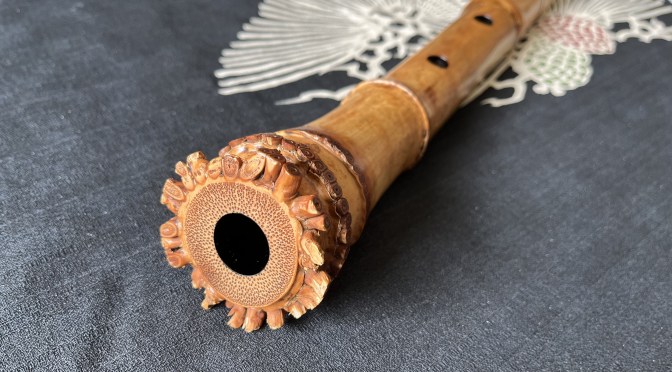
1. It is a very special instrument: its sounds is unique and will open a new world for you.

2. It is a deep breathing training: bringing your awareness to your breath is relaxing and a deep breathing training is very good for your health. It will help you find a quiet moment for yourself.

3. It is a challenging instrument:

  • physically: to get a sound, to keep it, to get the proper pitch.
  • mentally: to go on and don’t give up because it’s more difficult than what you thought. You can do it.
  • energetically: it’s a mirror of your energy level, and it will help you to improve it.
  • spiritually: you’ll have to let go of your self and accept what is given by the flute. Playing the old traditional music is a spiritual act.

4. It is a very old tradition, which reaches people deeply.

5. It will improve your concentration in your daily life.

6. It will bring peace in your life. And you’ll be able to share this peace with the people around you by playing shakuhachi for them.

Effective Tips for Memorising Shakuhachi Honkyoku

When I started playing in nature a few years ago, I quickly realised that I needed to learn my Honkyoku repertoire by heart. I wanted to be able to play anywhere, without relying on notation.

And then I made a huge discovery.

Why play Honkyoku by heart?

I wrote about this topic a few years ago (in this post), and looking back, I’m still using the same approach—only now, my repertoire has grown a lot.

Oral transmission

Traditional shakuhachi music is an oral tradition. Notation came later, mainly as a tool to remember and pass on the music. But you cannot truly play Honkyoku as it is meant to sound if you don’t know the style or have never heard it.

That’s why I make so many practice recordings for my students. You can find them on my SoundCloud page.

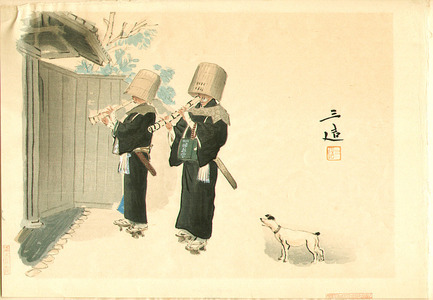
Playing by heart connects you more deeply to this tradition—and to yourself. Your listening shifts. You begin to follow in the footsteps of the Komusō monks.

Reading notation feels, to me, like a very Western approach, similar to classical music. Have you ever seen African drum players reading notation? Their rhythmic polyphony is incredibly complex and precise, yet learned without sheet music. This is just one example, but if you look at traditional music from around the world, you’ll notice how rarely musicians perform with written scores.

Benefits of playing Honkyoku by heart

Focus

The first benefit is that I can dedicate much more attention to listening: to my breath, to the quality of the sound, to expression, and to the silence between phrases.

Repertoire

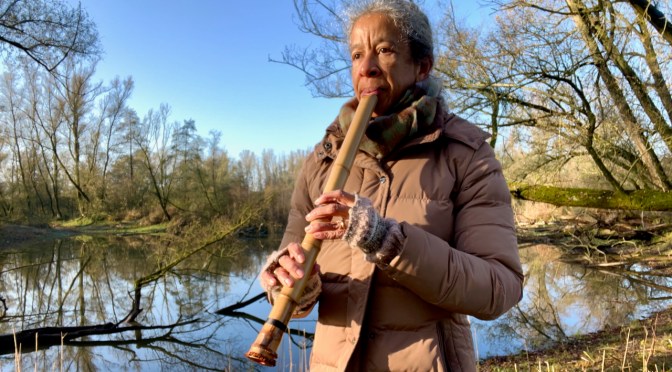
The more I play outdoors, the more my repertoire grows. I just pick up my shakuhachi and play my favourite pieces—no paper, no digital notation, no music stand needed.

Confidence

The more confident I become playing by heart in nature, the more confident I feel performing by heart in concert halls too.
In concerts in Europe and International Festivals, and even at the World Shakuhachi Festival in Texas, I performed by heart.

I often prepare for my performances in nature—like I did in Texas.

Even when I use notation, learning the piece by heart first gives me a deeper understanding of it and more room for expression.

Students’ feedback

I encourage my students to play by heart as well. Their feedback is always positive and valuable.

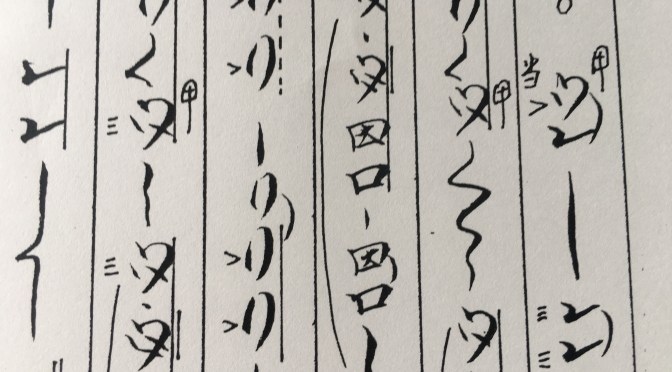
Last week, during a workshop, six of them performed by heart for the group. It was challenging, but magical to hear how each of them dared to express themselves through the music (the notations you see in the photos are from the group piece we were studying during the workshop; they are not the pieces the students performed for the group.)

Of course, part of the attention goes into avoiding mistakes, and that can create tension. But the same happens when reading a score. Learning by heart brings you a step deeper into the music.

Why is it difficult to learn Honkyoku by heart?

Koten Honkyoku is not particularly melodic or rhythmic—not something you can sing easily like a song (although singing the phrases can help with phrasing).

The music is built on patterns, sound colours, and breath length.
Many patterns reappear across different pieces, sometimes with small variations. This makes it easy to mix pieces—starting one and ending with another! Practice helps reduce this.

Learning by heart will help you understand the music better and eventually make it your own.

Tips for Learning by Heart

1. The First Steps

  • Study the piece thoroughly (with notation and recordings) until you can play it smoothly without hesitation.
  • Look at the title: what is the piece about?
  • Unfold the structure: where are the main sections? How do they transition?
  • Build your own “story.” Not necessarily a literal story—just something that makes the phrases and sections feel logical rather than random.

The Next Steps

  • Start with a short piece you know well.
  • Play a phrase while looking at the notation, then repeat it with your eyes closed.
  • Do the same with whole sections.
  • Always know exactly where you are. Whether you’re a visual or auditory learner, don’t rely only on the logical flow. Have your internal “GPS” ready for when you lose your place.
    => Practice starting from different points—not just the beginning. You should be able to start anywhere and play to the end.
  • Learn from your mistakes:
    – Why do they happen in a specific spot?
    – Is it random, or does it happen often?
    – What’s unclear in that phrase?
  • Record yourself and listen back with the notation. Fix inaccuracies.
  • Play along with a recording and notice when you diverge.
  • Go into nature and try again and again!

30-Minute Playing-by-Heart Challenge

I’m currently training my memory by starting each day with 30 minutes of Honkyoku played by heart.

Some pieces need refreshing, and I’m gradually adding new and longer ones.

Will you join the challenge?
Start with just 5 minutes a day and increase gradually.

I’d love to hear from you!

Kame-no-Shirabe: A Beginner’s Shakuhachi Composition

Kame-no-Shirabe 亀 の 調

I’m thrilled to announce that my new composition for beginners, Kame-no-Shirabe (Tortoise’s Melody), commissioned by the European Shakuhachi Society, has been published in their Bamboo Newsletter of June 2025.

I am the fourth composer of their “Ignition Commission” program, and the first European one!

Celebration of slowness

Slowness is the motto of the piece!

“With calm and tranquility you’ll reach your goals”.

If you sometimes feel like you are progressing slowly on your shakuhachi journey, this piece is a celebration of the slow pace of the tortoise. Slowness gives time to look at the details, to feel what is happening when you play, inside and out. It gives space to deepen your practice.
In some cultures, the tortoise is a symbol of wisdom, longevity and protection.

Listen

You can listen to my composition here:

My Works for Shakuhachi Beginners

Compositions

Beginners are very important for the future of shakuhachi, regardless of the student’s age. Their first steps with the flute are precious. As a teacher, I’m involved in helping them by providing personal instruction, but also in supporting their motivation with compositions and booklets especially written for their level.

These compositions are accessible to any beginner student regardless of his/her school, and they are available on this website here, as well as in my virtual dojo. Here is the list:

  • 10 Easy Pentatonic Melodies
  • 6 Elemental Melodies
  • Honkyoku for Beginners
  • Warm-up Routines

Practice Tips and Tutorial Videos

On this website, I’ve been sharing a lot of information, including practice tips.

However, the shakuhachi cannot be learned only with practice tips. For students who don’t have or cannot afford a teacher, I’ve created a virtual dojo, where I share tutorial videos, music notations, and more.

You can join for free, choose a monthly subscription or purchase scores and collections of posts in the shop.

Valuable content has value

Invitation to my Virtual Dojo

In my virtual shakuhachi dojo, you will find the sheet music of my latest composition, Kame-no-Shirabe, for free. All you need to do is register at the dojo (free of charge). The score is included in the post “Kame-no-Shirabe“.

To help practice the piece, I just published a short tutorial, which is my 50th tutorial video in my dojo! Just check it out!

What’s in my virtual dojo?

I have been working hard on the content of this dojo for over four years. The platform itself has developed many tools, allowing creators to share their works in a variety of ways.

This intimate space not only offers unique content but also allows you to connect personally with me. You’ll have access to the various aspects of shakuhachi that I work on, whether you’re a beginner wanting to learn the basics, a meditator looking to deepen your practice, or a more experienced player wishing to expand your repertoire with pieces from the Hijiri-Kai.

Check-it out here!

From the Heart

On March 2, 2025, I’ll be giving a free online workshop organised by the European Shakuhachi Society. Click here for information and registration.

If you are interested, please register even if you cannot attend the event live. You’ll get the teaching material and a link to watch it back afterwards.

From the Heart

The theme of the workshop is From the Heart. I’ll be teaching Nyoi Chōshi, which is a short prelude to a longer piece, Nyoi, composed by Miyakawa Nyozan at the end of the 19th century.

The level is beginner/elementary but the workshop will also be interesting for more advanced students. Going back to the basics is always good!

Playing a simple piece allows for more precision to pitch, ornementation, phrasing, tone quality, etc. The beginners’ version will allow participants to learn the main line and enjoy its simplicity (simple doesn’t mean easy!).

We will also work to embody the piece so that you can make it your own.

You learn honkyoku from notation but you play it from the heart.

Continue reading From the Heart

“Why the Shakuhachi matters in a divided World”

Happy and Healthy 2025!

I’m glad to share another inspiring post about shakuhachi written by the “Komuso Khronicles“: “The Shakuhachi: A tool for Interconnectedness Beyond Words, part 2” (see the original post down below).

A few reflections after reading the post

We cannot be reminded enough to stay connected to the essence of the shakuhachi. Whether it is during a public performance or a lesson with your teacher, what does really matter?
Your competitive mind, your ego, wants you to prove yourself. To prove yourself to yourself. To impress others and get external validation. To be good enough. To be the best.

The technical control on the flute is the way to express yourself the more accurately possible. It is a tool, not a goal.
Your sincere shakuhachi playing, the sounds you dare to share with the world, this is what matters. Breathe.

“Its sound bypasses the intellect and speaks directly to the heart, creating a space where differences dissolve, and unity prevails.”

What if you saw the shakuhachi as a bridge?

“A bridge between individuals, between the self and the universe, and between the personal and the universal. “

What if you saw the shakuhachi as a manifestation of impermanence?

Each note arises, resonates, and fades away, reflecting the impermanence of all things.

What if you saw what you’re experiencing while playing, performing, learning, practicing, breathing, as a tool to grow in your life?

The shakuhachi aligns with the personal dharma (duty or path) of self-discipline and growth. Learning to play it requires patience, focus, and humility, cultivating virtues that bring harmony to one’s life. Additionally, sharing its music can foster connections and peace within a community.

What if you saw the shakuhachi, however humble its international influence, as a profound and universal tool of interconnection?

Playing or listening to it can evoke a sense of unity with the cosmos, serving as a meditative practice that transcends individual ego and dualistic thinking.

“Why the Shakuhachi matters in a divided World?” Continue reading!

Continue reading “Why the Shakuhachi matters in a divided World”

World Shakuhachi Festival Texas 2025

Here are some information about the World Shakuhachi Festival Texas 2025, on April 17~20, 2025. Here is the link to the website: https://wsf2025.com

“WSF 2025 is the eighth major international shakuhachi festival to be held since the original 1994 WSF convened in Bisei, Okayama Prefecture, Japan. It will feature a diverse range of music in concerts, workshops, lectures, exhibitions, masterclasses, and informal gatherings, in a diverse range of genres such as jazz, contemporary music, cross-cultural fusion, improvisation, video games, rock, and pop, among others.”

The Early-Bird registration  is now open, until December 31, 2024.

The festival offers the possibility to apply for a scholarship to potential WSF 2025 participants from any country. Scholarship application deadline is December 15, 2024.

There will be a performer’s competition during the festival. This competition is open to all registered general participants of the World Shakuhachi Festival 2025. Deadline for submissions will be December 31st.

Have a look at the general schedule to get an idea of the program, and find all the details on the concerts and workshops pages. It is going to be amazing!

I feel honoured to be part of this unique event as an invited guest and to represent the Hijirikai school there!

Hope to see some of you there!

Shoshikan meditation practice and Shakuhachi

I’m reposting here an inspiring blogpost about the Shoshikan meditation practice from the blog “Komuso Khronicles” written by the Komuso monk Fuu. As mentioned at the beginning of the post:

Shoshikan (初心観), also known as “observation of the beginner’s mind,” is a Zen meditation practice that emphasizes maintaining a sense of curiosity, openness, and acceptance, free from preconceived notions or biases.

At every stage of your shakuhachi journey, it is essential to stay in touch with your beginner’s mind (curiosity, openness, acceptance, creativity, wonder, etc.). I sometimes see in my students the beginner’s enthusiasm fade when faced with the technical difficulties of the flute. Developing a non-judgemental attitude based on self-observation helps you navigate the ups and downs of the journey.

The article covers several important aspects of shakuhachi playing: Breath and Awareness, Tone Quality, Physical and Mental Posture, Unity of Breath-Body-Instrument, Self-Discovery and Connection to Nature, as well as a comparison between Shoshikan 照思観 and Suizen (吹禅 – Blowing zen)

Happy reading! Feel free to leave a comment and to subscribe to the Komuso Khronicles!

Shakuhachi Notation

As summer approaches – at least in my part of the world – I’m thrilled to announce that I’ll be teaching and performing at the European Shakuhachi Society Summer School in Finland from July 29th to August 1st! It promises to be an exciting opportunity for all involved.

When asked for my program, I selected two compositions by Fukuda Teruhisa sensei and two of my own compositions.

In a diverse summer school setting with various teachers and schools, I think our compositions would serve as an excellent introduction to the Hijirikai style, a modern school rooted in ancient tradition.

I’m excited to meet people in person again! If you’d like to join, click here to get all the information.

Shakuhachi Notation

Thinking about composition leads me to consider notation and various approaches to it.

Continue reading Shakuhachi Notation

10 years of Shakuhachi School!

Just a quick post in this busy period to celebrate with you the end of 2023 and the seven years of existence of this blog!

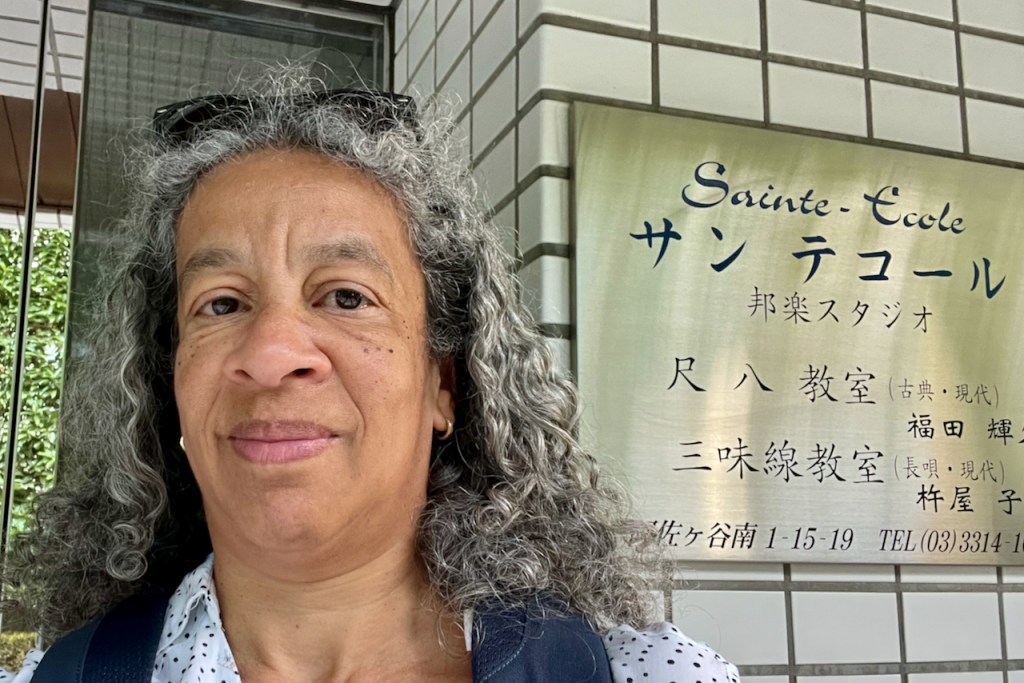
I look back on a rich year, the highlight of which was my trip to Japan, coinciding with the 10th anniversary of my shakuhachi school in the Netherlands, the Dutch branch of Hijiri-Kai (Sainte-École), founded by Fukuda Teruhisa in Tokyo, Japan.

What does a shakuhachi school mean nowadays in a Western country?

Continue reading 10 years of Shakuhachi School!

Shakuhachi Pilgrimage in Japan – Part 3 – A Komuso story

I started my trip in Japan visiting my shakuhachi master Fukuda Teruhisa in Tokyo. We practiced lots of music, including some of his compositions. For each piece, I asked him about the meaning and his intention. At a moment, I asked him if there was any particular order to play a set of pieces and he answered with a story, a Komuso story…

Continue reading Shakuhachi Pilgrimage in Japan – Part 3 – A Komuso story

Shakuhachi Pilgrimage in Japan – Part 2 – Nature

It was very important to me to play in nature during my trip to Japan. There is so much inspiration from nature in traditional honkyoku (solo music for shakuhachi) and in general in Japanese arts and culture, that reading about it was not enough, I wanted to experience it.

I had selected a few places I absolutely wanted to go to: mountains, bamboo forests, waterfalls. I practiced several pieces I wanted to play there. Playing in nature means obviously playing by heart.

Improvisation was not my goal, as I wanted to experience the connection between specific honkyoku and its environment.

And May was a fantastic month to listen to birds as well!

My short trip of 16 days was way too short to cover all that I wanted to discover, but the experience was very strong and I took back lots of inspiration.

Whenever, wherever, I play those pieces now, there is some of the memory of the Japanese nature in them.

Here are the highlights of my trip.

Continue reading Shakuhachi Pilgrimage in Japan – Part 2 – Nature

Hélène Seiyu Codjo