Tag Archives: Japanese traditional music

Effective Tips for Memorising Shakuhachi Honkyoku

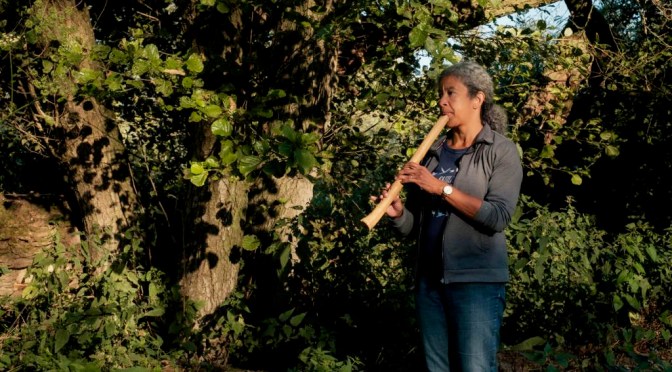
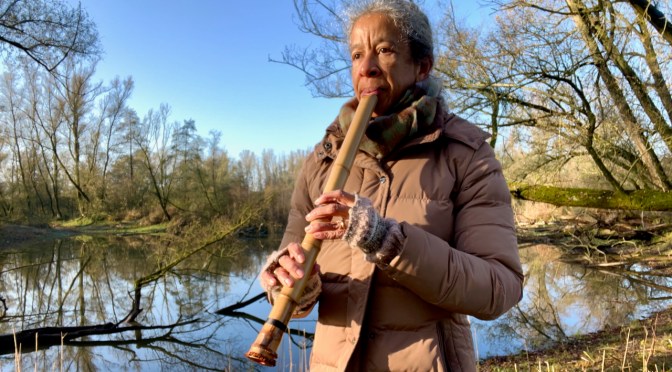
When I started playing in nature a few years ago, I quickly realised that I needed to learn my Honkyoku repertoire by heart. I wanted to be able to play anywhere, without relying on notation.

And then I made a huge discovery.

Why play Honkyoku by heart?

I wrote about this topic a few years ago (in this post), and looking back, I’m still using the same approach—only now, my repertoire has grown a lot.

Oral transmission

Traditional shakuhachi music is an oral tradition. Notation came later, mainly as a tool to remember and pass on the music. But you cannot truly play Honkyoku as it is meant to sound if you don’t know the style or have never heard it.

That’s why I make so many practice recordings for my students. You can find them on my SoundCloud page.

Playing by heart connects you more deeply to this tradition—and to yourself. Your listening shifts. You begin to follow in the footsteps of the Komusō monks.
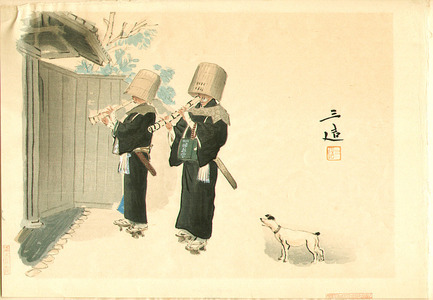
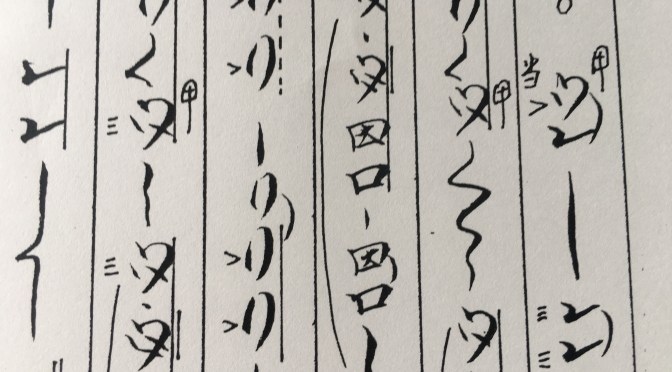
Reading notation feels, to me, like a very Western approach, similar to classical music. Have you ever seen African drum players reading notation? Their rhythmic polyphony is incredibly complex and precise, yet learned without sheet music. This is just one example, but if you look at traditional music from around the world, you’ll notice how rarely musicians perform with written scores.

Benefits of playing Honkyoku by heart

Focus

The first benefit is that I can dedicate much more attention to listening: to my breath, to the quality of the sound, to expression, and to the silence between phrases.

Repertoire

The more I play outdoors, the more my repertoire grows. I just pick up my shakuhachi and play my favourite pieces—no paper, no digital notation, no music stand needed.

Confidence

The more confident I become playing by heart in nature, the more confident I feel performing by heart in concert halls too.
In concerts in Europe and International Festivals, and even at the World Shakuhachi Festival in Texas, I performed by heart.

I often prepare for my performances in nature—like I did in Texas.

Even when I use notation, learning the piece by heart first gives me a deeper understanding of it and more room for expression.

Students’ feedback

I encourage my students to play by heart as well. Their feedback is always positive and valuable.

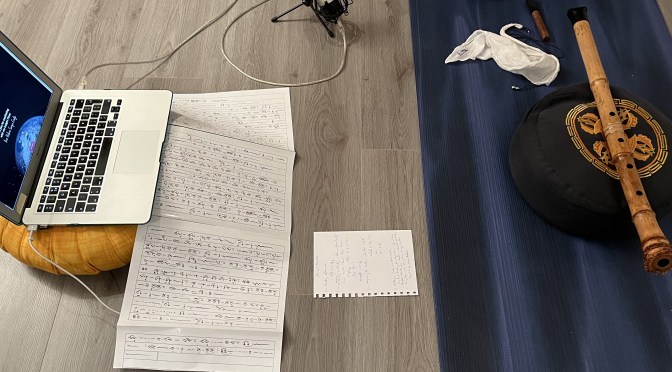
Last week, during a workshop, six of them performed by heart for the group. It was challenging, but magical to hear how each of them dared to express themselves through the music (the notations you see in the photos are from the group piece we were studying during the workshop; they are not the pieces the students performed for the group.)

Of course, part of the attention goes into avoiding mistakes, and that can create tension. But the same happens when reading a score. Learning by heart brings you a step deeper into the music.

Why is it difficult to learn Honkyoku by heart?

Koten Honkyoku is not particularly melodic or rhythmic—not something you can sing easily like a song (although singing the phrases can help with phrasing).

The music is built on patterns, sound colours, and breath length.
Many patterns reappear across different pieces, sometimes with small variations. This makes it easy to mix pieces—starting one and ending with another! Practice helps reduce this.

Learning by heart will help you understand the music better and eventually make it your own.

Tips for Learning by Heart

1. The First Steps

  • Study the piece thoroughly (with notation and recordings) until you can play it smoothly without hesitation.
  • Look at the title: what is the piece about?
  • Unfold the structure: where are the main sections? How do they transition?
  • Build your own “story.” Not necessarily a literal story—just something that makes the phrases and sections feel logical rather than random.

The Next Steps

  • Start with a short piece you know well.
  • Play a phrase while looking at the notation, then repeat it with your eyes closed.
  • Do the same with whole sections.
  • Always know exactly where you are. Whether you’re a visual or auditory learner, don’t rely only on the logical flow. Have your internal “GPS” ready for when you lose your place.
    => Practice starting from different points—not just the beginning. You should be able to start anywhere and play to the end.
  • Learn from your mistakes:
    – Why do they happen in a specific spot?
    – Is it random, or does it happen often?
    – What’s unclear in that phrase?
  • Record yourself and listen back with the notation. Fix inaccuracies.
  • Play along with a recording and notice when you diverge.
  • Go into nature and try again and again!

30-Minute Playing-by-Heart Challenge

I’m currently training my memory by starting each day with 30 minutes of Honkyoku played by heart.

Some pieces need refreshing, and I’m gradually adding new and longer ones.

Will you join the challenge?
Start with just 5 minutes a day and increase gradually.

I’d love to hear from you!

Shakuhachi Notation

As summer approaches – at least in my part of the world – I’m thrilled to announce that I’ll be teaching and performing at the European Shakuhachi Society Summer School in Finland from July 29th to August 1st! It promises to be an exciting opportunity for all involved.

When asked for my program, I selected two compositions by Fukuda Teruhisa sensei and two of my own compositions.

In a diverse summer school setting with various teachers and schools, I think our compositions would serve as an excellent introduction to the Hijirikai style, a modern school rooted in ancient tradition.

I’m excited to meet people in person again! If you’d like to join, click here to get all the information.

Shakuhachi Notation

Thinking about composition leads me to consider notation and various approaches to it.

Continue reading Shakuhachi Notation

10 years of Shakuhachi School!

Just a quick post in this busy period to celebrate with you the end of 2023 and the seven years of existence of this blog!

I look back on a rich year, the highlight of which was my trip to Japan, coinciding with the 10th anniversary of my shakuhachi school in the Netherlands, the Dutch branch of Hijiri-Kai (Sainte-École), founded by Fukuda Teruhisa in Tokyo, Japan.

What does a shakuhachi school mean nowadays in a Western country?

Continue reading 10 years of Shakuhachi School!

Shakuhachi Pilgrimage in Japan – Part 3 – A Komuso story

I started my trip in Japan visiting my shakuhachi master Fukuda Teruhisa in Tokyo. We practiced lots of music, including some of his compositions. For each piece, I asked him about the meaning and his intention. At a moment, I asked him if there was any particular order to play a set of pieces and he answered with a story, a Komuso story…

Continue reading Shakuhachi Pilgrimage in Japan – Part 3 – A Komuso story

Shakuhachi Pilgrimage in Japan – Part 2 – Nature

It was very important to me to play in nature during my trip to Japan. There is so much inspiration from nature in traditional honkyoku (solo music for shakuhachi) and in general in Japanese arts and culture, that reading about it was not enough, I wanted to experience it.

I had selected a few places I absolutely wanted to go to: mountains, bamboo forests, waterfalls. I practiced several pieces I wanted to play there. Playing in nature means obviously playing by heart.

Improvisation was not my goal, as I wanted to experience the connection between specific honkyoku and its environment.

And May was a fantastic month to listen to birds as well!

My short trip of 16 days was way too short to cover all that I wanted to discover, but the experience was very strong and I took back lots of inspiration.

Whenever, wherever, I play those pieces now, there is some of the memory of the Japanese nature in them.

Here are the highlights of my trip.

Continue reading Shakuhachi Pilgrimage in Japan – Part 2 – Nature

Shakuhachi Pilgrimage in Japan 2023 – PART 1

Inspiration

I’d been preparing this trip for months, almost for years. I had dreamt it, imagined, looked up, planed, prepared, organised, booked…

As a result, it went beyond expectations.

The three main aspects of this shakuhachi trip were:
1. Study: studying with my master Fukuda Teruhisa in Tokyo and getting my Dai Shihan diploma (Grand Master)
2. Nature: walking and playing in nature on my own
3. Spirituality: going to different important places for Buddhism and meeting Komuso monks in Nara.

There is so much to say about it that I don’t know where to start!

By the beginning I guess, which is INSPIRATION.

So let’s take a deep breath in together…

Continue reading Shakuhachi Pilgrimage in Japan 2023 – PART 1

A Shakuhachi Trip to Japan!

Happy 2023 and Happy New Year of the Rabbit!

Hope you’re having a good start of the New Year. Did you make good resolutions? Do you have a new motto?

My motto for this year is one I took from the online yoga teacher Kassandra Reinhardt, whose videos I’m practicing daily.

🎶 I’m worthy of good things 🎉

Joy, Shakuhachi music in tree pose.

So what is my big project for 2023?

Continue reading A Shakuhachi Trip to Japan!

Online Shakuhachi Performances

The Covid-19 pandemic has initiated new activities in my life as a professional shakuhachi player, which is to perform online. I had some resistance at the beginning of the pandemic and it took me time to surrender to the situation… and start performing online.

And now, I’m really liking it. It is very different from physical performances of course and I do miss the direct interaction with the audience, but it feels special to be connected at the same time to people sitting in different places in the world. And there is sometimes even a more personal interaction with the audience through the chat than during a real concert.

This keeps me going. I’m not waiting anymore for the “old situation” to come back, I don’t believe it ever will. So I’m building up with what is possible for me here and now.

So I’m very happy to announce my next online performances!

Continue reading Online Shakuhachi Performances

The Sound of Nature and Shakuhachi

A Shakuhachi Podcast

In July, my student Christof Zürn, creator of Music Thinking, interviewed me for a podcast about shakuhachi. You can listen to it here .

Earlier this year, we prepared the interview with having an improvisation session in nature, that we recorded.  Christof mixed some moments of it in the podcast and I published a short video on my YouTube Channel.
We had fun with the geese flowing by, pieces of trees falling on us… We also played Kyorei together. Watch it here:

Shakuhachi belongs to nature

A few days after the podcast was released, I found a very interesting paper about Japanese music, written by Akikazu Nakamura. I already had the deep conviction that honkyoku music takes another dimension when played outside. This paper confirms my experience and gives some very interesting insights about Japanese music, that are important to know in order to improve one’s understanding of playing Japanese music. Here is a short summary and analysis of Nakamura’s paper.

Continue reading The Sound of Nature and Shakuhachi

Deep Breathing Meditation

What is your relationship with your breathing? Do you ignore it, train it, observe it?… Has the Covid-19 pandemic affected your awareness about your breathing in any way?

Blowing the shakuhachi is a deep breathing training. Over the years, I notice that my breathing’s awareness and quality have improved, and as a result, the connection with my breathing has increased my inner peace, my ability to manage my emotions, and more generally, my feeling of happiness.

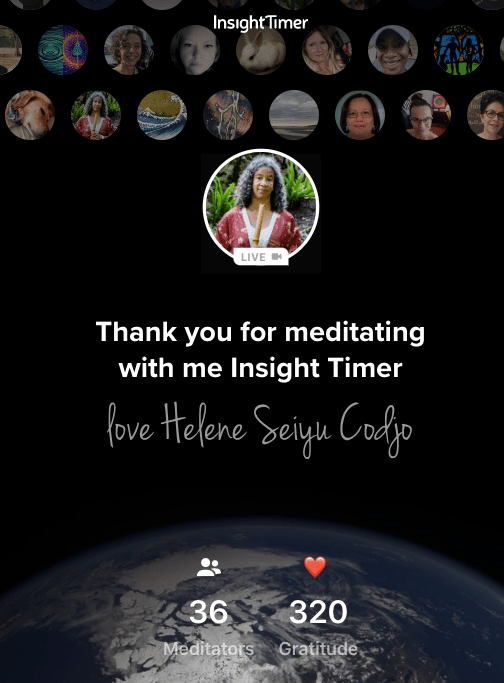
Since February 2022, I give live meditation sessions of the app Insight Timer. I share with the participants the deep breathing meditation training in relation to the musical tradition of shakuhachi, which combines the unique sounds of the flute with inspiring music.
Being connected with people from all over the world at the same time is really special.

These sessions are FREE, so don’t hesitate to follow me and attend my sessions!

You can also train by yourself anytime, listening to my audio meditations on the app. Keep reading to discover how.

Subscribe to my blog here and don’t miss any post:

Continue reading Deep Breathing Meditation