Tag Archives: Honkyoku

Effective Tips for Memorising Shakuhachi Honkyoku

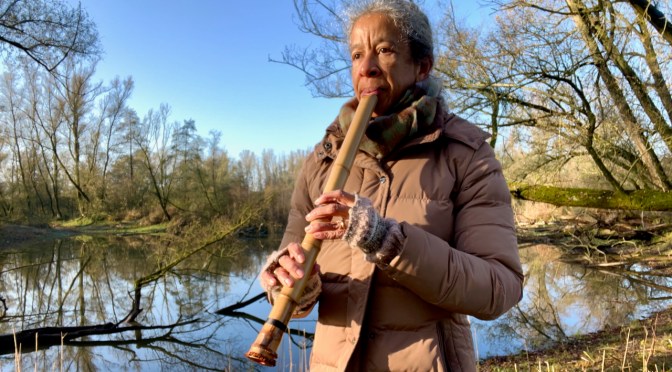
When I started playing in nature a few years ago, I quickly realised that I needed to learn my Honkyoku repertoire by heart. I wanted to be able to play anywhere, without relying on notation.

And then I made a huge discovery.

Why play Honkyoku by heart?

I wrote about this topic a few years ago (in this post), and looking back, I’m still using the same approach—only now, my repertoire has grown a lot.

Oral transmission

Traditional shakuhachi music is an oral tradition. Notation came later, mainly as a tool to remember and pass on the music. But you cannot truly play Honkyoku as it is meant to sound if you don’t know the style or have never heard it.

That’s why I make so many practice recordings for my students. You can find them on my SoundCloud page.

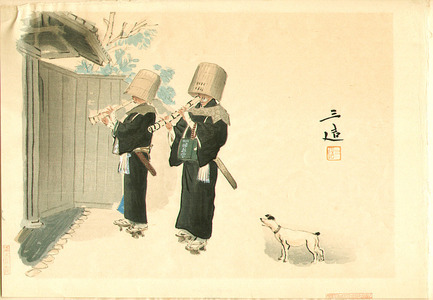
Playing by heart connects you more deeply to this tradition—and to yourself. Your listening shifts. You begin to follow in the footsteps of the Komusō monks.

Reading notation feels, to me, like a very Western approach, similar to classical music. Have you ever seen African drum players reading notation? Their rhythmic polyphony is incredibly complex and precise, yet learned without sheet music. This is just one example, but if you look at traditional music from around the world, you’ll notice how rarely musicians perform with written scores.

Benefits of playing Honkyoku by heart

Focus

The first benefit is that I can dedicate much more attention to listening: to my breath, to the quality of the sound, to expression, and to the silence between phrases.

Repertoire

The more I play outdoors, the more my repertoire grows. I just pick up my shakuhachi and play my favourite pieces—no paper, no digital notation, no music stand needed.

Confidence

The more confident I become playing by heart in nature, the more confident I feel performing by heart in concert halls too.
In concerts in Europe and International Festivals, and even at the World Shakuhachi Festival in Texas, I performed by heart.

I often prepare for my performances in nature—like I did in Texas.

Even when I use notation, learning the piece by heart first gives me a deeper understanding of it and more room for expression.

Students’ feedback

I encourage my students to play by heart as well. Their feedback is always positive and valuable.

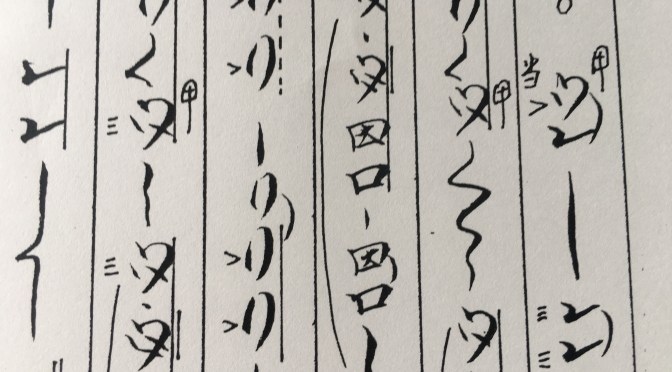
Last week, during a workshop, six of them performed by heart for the group. It was challenging, but magical to hear how each of them dared to express themselves through the music (the notations you see in the photos are from the group piece we were studying during the workshop; they are not the pieces the students performed for the group.)

Of course, part of the attention goes into avoiding mistakes, and that can create tension. But the same happens when reading a score. Learning by heart brings you a step deeper into the music.

Why is it difficult to learn Honkyoku by heart?

Koten Honkyoku is not particularly melodic or rhythmic—not something you can sing easily like a song (although singing the phrases can help with phrasing).

The music is built on patterns, sound colours, and breath length.
Many patterns reappear across different pieces, sometimes with small variations. This makes it easy to mix pieces—starting one and ending with another! Practice helps reduce this.

Learning by heart will help you understand the music better and eventually make it your own.

Tips for Learning by Heart

1. The First Steps

  • Study the piece thoroughly (with notation and recordings) until you can play it smoothly without hesitation.
  • Look at the title: what is the piece about?
  • Unfold the structure: where are the main sections? How do they transition?
  • Build your own “story.” Not necessarily a literal story—just something that makes the phrases and sections feel logical rather than random.

The Next Steps

  • Start with a short piece you know well.
  • Play a phrase while looking at the notation, then repeat it with your eyes closed.
  • Do the same with whole sections.
  • Always know exactly where you are. Whether you’re a visual or auditory learner, don’t rely only on the logical flow. Have your internal “GPS” ready for when you lose your place.
    => Practice starting from different points—not just the beginning. You should be able to start anywhere and play to the end.
  • Learn from your mistakes:
    – Why do they happen in a specific spot?
    – Is it random, or does it happen often?
    – What’s unclear in that phrase?
  • Record yourself and listen back with the notation. Fix inaccuracies.
  • Play along with a recording and notice when you diverge.
  • Go into nature and try again and again!

30-Minute Playing-by-Heart Challenge

I’m currently training my memory by starting each day with 30 minutes of Honkyoku played by heart.

Some pieces need refreshing, and I’m gradually adding new and longer ones.

Will you join the challenge?
Start with just 5 minutes a day and increase gradually.

I’d love to hear from you!

From the Heart

On March 2, 2025, I’ll be giving a free online workshop organised by the European Shakuhachi Society. Click here for information and registration.

If you are interested, please register even if you cannot attend the event live. You’ll get the teaching material and a link to watch it back afterwards.

From the Heart

The theme of the workshop is From the Heart. I’ll be teaching Nyoi Chōshi, which is a short prelude to a longer piece, Nyoi, composed by Miyakawa Nyozan at the end of the 19th century.

The level is beginner/elementary but the workshop will also be interesting for more advanced students. Going back to the basics is always good!

Playing a simple piece allows for more precision to pitch, ornementation, phrasing, tone quality, etc. The beginners’ version will allow participants to learn the main line and enjoy its simplicity (simple doesn’t mean easy!).

We will also work to embody the piece so that you can make it your own.

You learn honkyoku from notation but you play it from the heart.

Continue reading From the Heart

World Shakuhachi Festival Texas 2025

Here are some information about the World Shakuhachi Festival Texas 2025, on April 17~20, 2025. Here is the link to the website: https://wsf2025.com

“WSF 2025 is the eighth major international shakuhachi festival to be held since the original 1994 WSF convened in Bisei, Okayama Prefecture, Japan. It will feature a diverse range of music in concerts, workshops, lectures, exhibitions, masterclasses, and informal gatherings, in a diverse range of genres such as jazz, contemporary music, cross-cultural fusion, improvisation, video games, rock, and pop, among others.”

The Early-Bird registration  is now open, until December 31, 2024.

The festival offers the possibility to apply for a scholarship to potential WSF 2025 participants from any country. Scholarship application deadline is December 15, 2024.

There will be a performer’s competition during the festival. This competition is open to all registered general participants of the World Shakuhachi Festival 2025. Deadline for submissions will be December 31st.

Have a look at the general schedule to get an idea of the program, and find all the details on the concerts and workshops pages. It is going to be amazing!

I feel honoured to be part of this unique event as an invited guest and to represent the Hijirikai school there!

Hope to see some of you there!

Shakuhachi Notation

As summer approaches – at least in my part of the world – I’m thrilled to announce that I’ll be teaching and performing at the European Shakuhachi Society Summer School in Finland from July 29th to August 1st! It promises to be an exciting opportunity for all involved.

When asked for my program, I selected two compositions by Fukuda Teruhisa sensei and two of my own compositions.

In a diverse summer school setting with various teachers and schools, I think our compositions would serve as an excellent introduction to the Hijirikai style, a modern school rooted in ancient tradition.

I’m excited to meet people in person again! If you’d like to join, click here to get all the information.

Shakuhachi Notation

Thinking about composition leads me to consider notation and various approaches to it.

Continue reading Shakuhachi Notation

Shakuhachi Pilgrimage in Japan – Part 3 – A Komuso story

I started my trip in Japan visiting my shakuhachi master Fukuda Teruhisa in Tokyo. We practiced lots of music, including some of his compositions. For each piece, I asked him about the meaning and his intention. At a moment, I asked him if there was any particular order to play a set of pieces and he answered with a story, a Komuso story…

Continue reading Shakuhachi Pilgrimage in Japan – Part 3 – A Komuso story

Shakuhachi Pilgrimage in Japan – Part 2 – Nature

It was very important to me to play in nature during my trip to Japan. There is so much inspiration from nature in traditional honkyoku (solo music for shakuhachi) and in general in Japanese arts and culture, that reading about it was not enough, I wanted to experience it.

I had selected a few places I absolutely wanted to go to: mountains, bamboo forests, waterfalls. I practiced several pieces I wanted to play there. Playing in nature means obviously playing by heart.

Improvisation was not my goal, as I wanted to experience the connection between specific honkyoku and its environment.

And May was a fantastic month to listen to birds as well!

My short trip of 16 days was way too short to cover all that I wanted to discover, but the experience was very strong and I took back lots of inspiration.

Whenever, wherever, I play those pieces now, there is some of the memory of the Japanese nature in them.

Here are the highlights of my trip.

Continue reading Shakuhachi Pilgrimage in Japan – Part 2 – Nature

Deep Breathing Meditation

What is your relationship with your breathing? Do you ignore it, train it, observe it?… Has the Covid-19 pandemic affected your awareness about your breathing in any way?

Blowing the shakuhachi is a deep breathing training. Over the years, I notice that my breathing’s awareness and quality have improved, and as a result, the connection with my breathing has increased my inner peace, my ability to manage my emotions, and more generally, my feeling of happiness.

Since February 2022, I give live meditation sessions of the app Insight Timer. I share with the participants the deep breathing meditation training in relation to the musical tradition of shakuhachi, which combines the unique sounds of the flute with inspiring music.
Being connected with people from all over the world at the same time is really special.

These sessions are FREE, so don’t hesitate to follow me and attend my sessions!

You can also train by yourself anytime, listening to my audio meditations on the app. Keep reading to discover how.

Subscribe to my blog here and don’t miss any post:

Continue reading Deep Breathing Meditation

Playing Shakuhachi in Nature

It’s when I play shakuhachi in nature that I experience the full power of it. Why? How?

Continue reading Playing Shakuhachi in Nature

Stress and Shakuhachi (Part 3) – Practices to reduce stress

I don’t know for you, but for me 2021 is being even more challenging than 2020. Or is it that, thanks to my meditation and shakuhachi practice, I become more and more aware of my own stress? And others’ stress as well?

In any case, I would like to give a follow up to the two posts about Stress and Shakuhachi that I wrote last year (Part 1 and Part 2).

In those posts, I wrote about the stress you can experience while playing shakuhachi (or any other music instrument) in front of others (teacher, public performance,…) and how to practice to reduce it.

In this post however, I’d like to address how the wisdom of shakuhachi can help you in your daily life to become aware of your own stress… and work on it.

Continue reading Stress and Shakuhachi (Part 3) – Practices to reduce stress

Shakuhachi Secrets

There is something mysterious in shakuhachi, mysterious and profound. Is it in the sound? Is it in the notation? Is it in the music?
I remember the lessons with Fukuda Teruhisa sensei, when we were avidly listening to his explanations with the hope of understanding the music and the notation a bit better. I am not talking about how to play the piece technically. I am talking about how to play it properly and uncover its secrets. It could sometimes seem unclear because it asked us to listen even more carefully to our sensei, to the music and to ourselves. Playing shakuhachi is a quest towards one’s self. It is much more than making sounds with a flute.

Continue reading Shakuhachi Secrets