
Tag Archives: Spirituality

Practicing Kokū 虚空

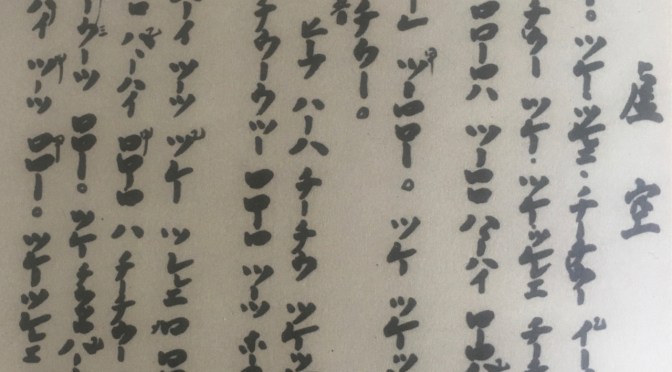
Kokū is considered one of the oldest compositions for shakuhachi, one of the three fundamental pieces together with Kyorei and Mukaiji.

Koku means “Empty Space,” or “Empty Sky,” (“Ko,” “empty”, and “Ku” “space”, or “sky”.)

There are many legends about this piece, and many different versions. Some versions are based on the story of the “Bell Ringing in an Empty Sky”. It refers to the death of the monk Fuke and his disappearance from his coffin. Only remains the sound of his bell coming from the empty sky. Other legends say that this piece has been composed in the 12th century by the monk Kyochiku, who heard this melody in a mystical dream. With the mist blocking the moon, it looked like the sound of the flute was coming from an empty sky.

Koku has a flavor of infinite mist and echoes. It is said that playing this piece helps one explore the boundaries of “mu” or nothingness, transcending reifications, the artificial cognitive boxes into which we place objects, situations and emotions.

Source: The International Shakuhachi Society
Continue reading Practicing Kokū 虚空

Performances

I’ve been performing since I’m fifteen, and I’ve never learned how to do it. I didn’t even think there was something to learn about it. However, when you think back to how many  people get nervous when they have to perform, from good anxiety to total panic that they have to calm down with medicines or even stronger stuff, you start to ask yourself whether there might be somehow something to learn about it. I can still remember moments of total panic during competitions and it didn’t feel good. Playing music shouldn’t lead to this amount of stress. At a lower level, I also experienced the frustration of practicing so hard for a lesson and then not being able to play the way I wanted when in presence of my teacher and the other students. So, is there something you can do about it?

Continue reading Performances

Karl Jenkins – Requiem

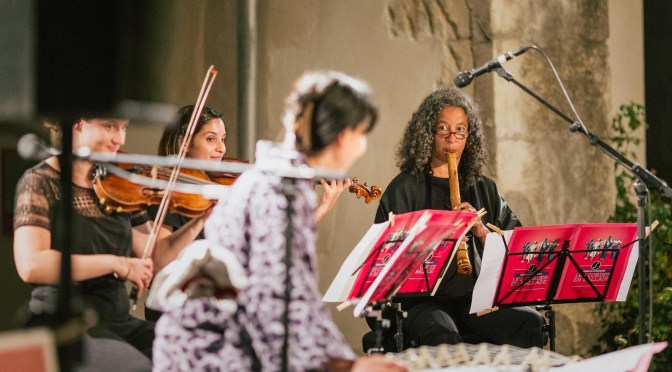
The Requiem (2004) of Karl Jenkins is a very special piece to me. It is written for orchestra and choir (with a soprano solo part) and shakuhachi. In addition to the usual movements of a Requiem (Latin mass for the soul of the dead), Jenkins chose 5 Japanese haikus (poems) about the cycle of life and death. These poems are sung by the women of the choir, accompanied by the orchestra and a solo shakuhachi part. The music is written in Western notation, and can be played by a transverse flute instead, if there is no shakuhachi player. Of course, the effects and colours are then totally different. The Western notation allows the shakuhachi player to choose his/her own fingerings and lengths of flutes and go deeper in the music by making his/her own interpretation. This piece allows me to use my classical background as a flutist to perform Japanese shakuhachi in a classical music setting, uniting my two musical worlds.

I’ll be performing this piece on March 18 in Ede and on May 4 in Middelburg (The Netherlands). A nice opportunity for the audience to discover the shakuhachi “live”.

Continue reading Karl Jenkins – Requiem