Category Archives: Daily life

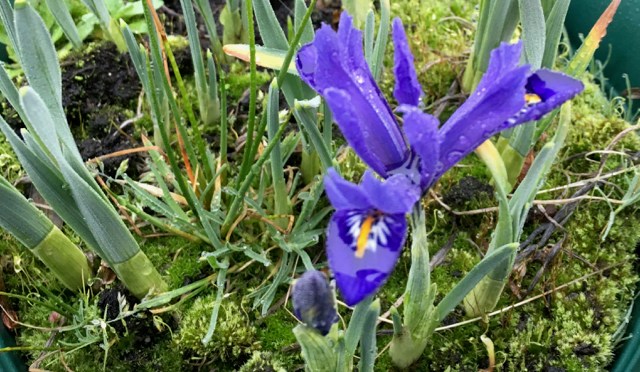
Iris, March 2017

Monthly visit at the dementia care home

From my audience in the department called “Iris”, two people passed away. One of them was Mrs Kisses. She was 90. I’m happy to have met her, to have had time to write a few lines about her, and to remember her thanks to the nickname I gave her, which instantly brings back memories, which her real name doesn’t. I won’t forget her kisses.

Sakura Sakura (Cherry Blossoms)

It was a grey rainy day so I decided to play the song Sakura Sakura, with all kind of variations and introductions, to bring some Spring feeling to the patients. That was much appreciated. It feels good to see that the seasons still mean something to the patients, even though most of them don’t go outside anymore.

Continue reading Iris, March 2017

Ups and downs

Ups and downs

That’s life, isn’t it?

My last weeks were quite hilly, in matter of ups and downs, and so was my shakuhachi practice as well.

Last Thursday, I was very excited because I did a big step forward. At least, it’s how it felt at the moment. Since last summer, I’m trying to broaden my range of tone colours and increase the resonance of my sound. I started this practice in the hills of the Plateau de Langres in France (which is not flat by the way), listening to the echo, and then everywhere, over and over again. And last Thursday, I found the right tone quality to make the radiator resonating. That was great (I had the feeling it was a matter of more harmonics in the sound, but I’m not quite sure). On Friday however, although the radiator was singing again on each Tsu I played  (while still heating the room properly), I felt I was in a down day. My energy was low, my sound was not as good as the day before… you have those days… I asked myself what could have changed: I actually spent more physical energy before starting my shakuhachi practice on Friday than on Thursday. Could be an explanation.

Continue reading Ups and downs

De Brug, February 14, 2017

In the dementia care home where I regularly play shakuhachi,”De Brug”, The Bridge, is the first department of the closed area. The people I see there walking around have still a foot in the outside life and the other foot… well, it looks like they don’t exactly know where they are. They are still looking for their husband or wife, wanting to go back home to prepare dinner, worrying about their mother to visit or their children to pick up at school. One woman asks us today where the busstop is to go to the city center. When she realises she doesn’t have money to pay her ticket, she doesn’t know what to do anymore. She eventually goes back to her bedroom. They don’t always remember where their bedroom is. They don’t feel home.

Continue reading De Brug, February 14, 2017

Shakuhachi and dementia: how it started

April 2014

I’m starting a volunteer job in a dementia care home, playing shakuhachi for the people in their bedrooms (individual visits) and during a massage activity (small group). I’ve never done that before and don’t know what to expect. I’m told that the goal is to connect to the patients, in one way or another, to reach them through the music. All kind of emotions can occur. “Don’t insist if they don’t want it or if it’s not the right moment, and don’t take it personal if they react negatively.” That was my formation for this job. Let’s do it!

Continue reading Shakuhachi and dementia: how it started

A nature funeral

She lies in her bed, in the living-room, close to the window with view on the garden. I’m playing for her, from a distance, very softly, I don’t even see her under the blankets. I don’t know if she can hear me. In a couple of weeks, she will be dead.

I met the family in a sunny afternoon of October, after I received a unusual and touching email. “My wife is dying, she asks for live shakuhachi music to be played at her funeral, is this something we can ask you?”  Continue reading A nature funeral

Waterlelie, January 2017

I’m coming again, first time after the Christmas holidays. It’s a sunny and very cold day outside. Inside it’s very warm as ever. You don’t really feel the seasons here, it’s always very warm.

Going to the closed world of people stuck in their minds. Front door with security, first door with code, corridors, second door with code, corridors, turn right, turn left, here I am.

The first person we visit is Mrs Kisses. I give her this nickname because when she’s enjoying something, she grabs your hand to kiss it. Last time I was in her bedroom, it was her birthday, I think she turned 90 but I’m not sure anymore. I remember I hesitated to play a birthday song but I finally didn’t. She looks at us, not really reacting. And then she sees the flute, her eyes light up, and she points her finger to it with a big smile. And she starts to kiss A.’s hands.

When I started to play for people with dementia almost 3 years ago, I was told they won’t recognise me even if I was coming every day. From the beginning, I could notice that, although they most likely didn’t remember me, some of them did recognise the shakuhachi. Each time this happens, it gives me a warm feeling. Continue reading Waterlelie, January 2017

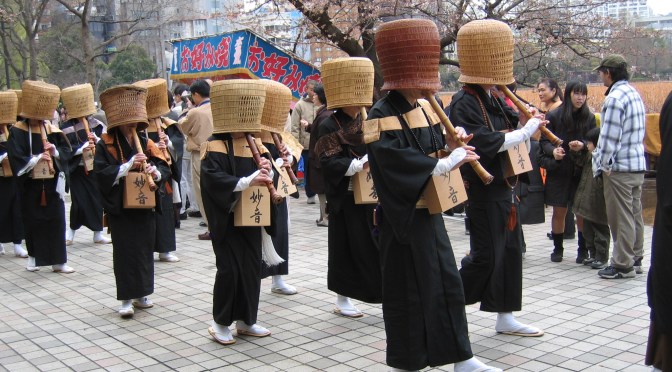
Komuso monks in Tokyo, April 2005

My first day in Japan, my first day in Tokyo… I didn’t know where to go so I decided to go to a park. Seeking nature in such a big city instead of running to see temples, modern buildings, palaces, shops, museums… that’s me…

At that time, I knew very little about the shakuhachi. I had one, I had taken a few lessons but I wasn’t getting much further than playing the basic notes and a few simple melodies. I had taken my shakuhachi in my suitcase -“to play in the metro” said ironically to me a musician of our orchestra- to see if I would get more inspired to play it in Japan. It’s not that I missed inspiration or desire to play it, no at the time I missed time to think and make a decision. Actually I took this time just before going to Japan, but was not conscious yet that shakuhachi was part of the choices I would have to make in my life. Continue reading Komuso monks in Tokyo, April 2005

Good resolutions

My good resolutions for 2016 were these 12 zen-rules I found somewhere on the web (my apologies to the author, I don’t know anymore where I read them).

Zen – 12 essential rules

  1. Do one thing at a time
  2. Do it slowly and deliberately
  3. Do it completely
  4. Do less
  5. Put space between things
  6. Develop rituals
  7. Designate time for certain things
  8. Devote time to sitting
  9. Smile and serve others
  10. Make cleaning and cooking become meditation
  11. Think about what is necessary
  12. Live simply

I had the feeling that they could help me to improve things in my life. One year later, reading them again, I can see what I already managed to improve and where I still need to work on.

I can apply some of them pretty well to the shakuhachi: Nr.1-2-3-5-6-8 are easily related to the way I use the shakuhachi to meditate (read here how).
Nr 5, “put space between things“, makes me think of the Japanese “ma“. In daily life, it also means for me “take a break regularly”.

But I still have a long way to go, so my good resolutions for 2017 remain these 12 rules, with emphasis on Nr.4 “do less” and Nr.11 “think about what is necessary“, with the help of Nr.5 again (“put space between things“) and Nr.7 “designate time for certain things“. Actually, they are all about making choices… apparently, that’s what I need for this new year.

For Nr.10, I think I manage pretty well with cooking as a meditation moment, but I still have to work hard on the cleaning!

To be continued…