
Tag Archives: Japanese traditional music

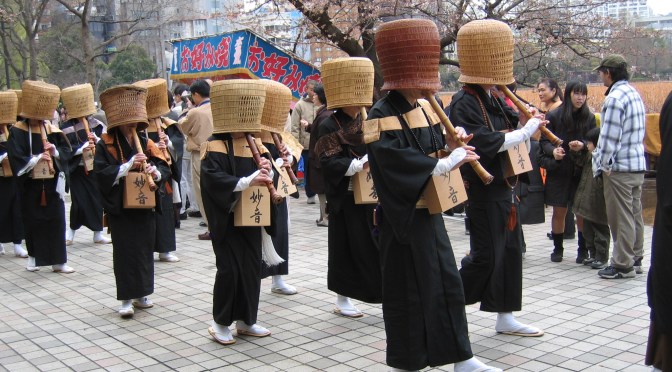
Komuso monks in Tokyo, April 2005

My first day in Japan, my first day in Tokyo… I didn’t know where to go so I decided to go to a park. Seeking nature in such a big city instead of running to see temples, modern buildings, palaces, shops, museums… that’s me…

At that time, I knew very little about the shakuhachi. I had one, I had taken a few lessons but I wasn’t getting much further than playing the basic notes and a few simple melodies. I had taken my shakuhachi in my suitcase -“to play in the metro” said ironically to me a musician of our orchestra- to see if I would get more inspired to play it in Japan. It’s not that I missed inspiration or desire to play it, no at the time I missed time to think and make a decision. Actually I took this time just before going to Japan, but was not conscious yet that shakuhachi was part of the choices I would have to make in my life. Continue reading Komuso monks in Tokyo, April 2005

Ro-buki

“If you have only five minutes in your day to practice your shakuhachi, play RO” (Fukuda Teruhisa).

Otsu-no-RO is the lowest note on the shakuhachi, all holes are closed. Practicing RO is very good your for your breath and embouchure control, and also to concentrate on the way you hold your  flute. It’s a good exercise to be aware of the tensions of your body and try to remove them, and find the just balance between relaxation and keeping the proper shape of the sound. It is recommended to blow RO at least 5 minutes, up to 10 minutes and it can be part of your daily meditation with shakuhachi practice.
Longer is of course possible, as long as you stay concentrated and don’t cramp. Blowing Kan-no-RO is also an interesting alternative I’ll develop later.

I found a few months ago on the website of Alcvin Ryuzen Ramos some very interesting variations to the practice of RO-buki. They give the possibility to train a large range of sounds while practicing only one tone… a shakuhachi achievement… Here are his tips, combining blowing and dynamics training:

Continue reading Ro-buki

5 good reasons to take lessons from a certified teacher

5 good reasons to take lessons from a certified teacher

  1. You will play at the proper pitch and don’t sound a semitone lower, blaming it on the flute.
  2. You will learn the specific techniques which make it unique.
  3. You will learn the traditional repertoire which is exclusively transmitted from master to student.
  4. You will meet fellow students, share your experience and play together.
  5. You will make progress.

6 good reasons to learn shakuhachi

6 good reasons to learn shakuhachi

1. It is a very special instrument: its sounds is unique and will open a new world for you.

2. It is a deep breathing training: bringing your awareness to your breath is relaxing and a deep breathing training is very good for your health. It will help you find a quiet moment for yourself.

3. It is a challenging instrument:

  • physically: to get a sound, to keep it, to get the proper pitch.
  • mentally: to go on and don’t give up because it’s more difficult than what you thought. You can do it.
  • energetically: it’s a mirror of your energy level, and it will help you to improve it.
  • spiritually: you’ll have to let go of your self and accept what is given by the flute. Playing the old traditional music is a spiritual act.

4. It is a very old tradition, which reaches people deeply.

5. It will improve your concentration in your daily life.

6. It will bring peace in your life. And you’ll be able to share this peace with the people around you by playing shakuhachi for them.