
Inspiration
I’d been preparing this trip for months, almost for years. I had dreamt it, imagined, looked up, planed, prepared, organised, booked…
As a result, it went beyond expectations.
The three main aspects of this shakuhachi trip were:
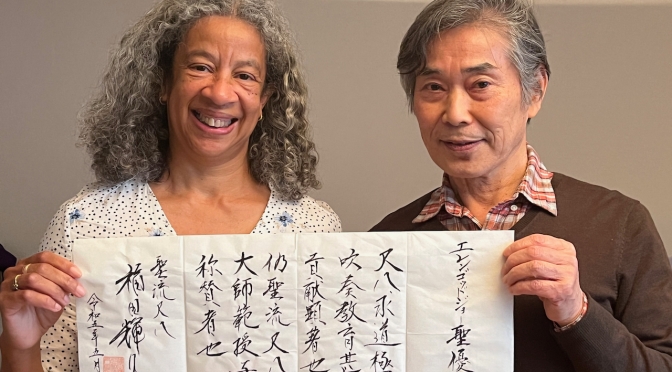
1. Study: studying with my master Fukuda Teruhisa in Tokyo and getting my Dai Shihan diploma (Grand Master)
2. Nature: walking and playing in nature on my own
3. Spirituality: going to different important places for Buddhism and meeting Komuso monks in Nara.
There is so much to say about it that I don’t know where to start!
By the beginning I guess, which is INSPIRATION.
So let’s take a deep breath in together…
PART 1. TOKYO
I was so happy to meet Fukuda sensei again, after more than four years! It was great to study with him, play together, exchange, be together.
And yes, I got my Dai Shihan license!!

Such an honour.
If you would like to know more about the different levels, here is a link to a very good article written by the shakuhachi master Shawn Renzoh Head.
This is what he writes about Dai Shihan:
Dai Shihan (大師範) represents the highest level of teaching certification and mastery of the shakuhachi. It is a rank that is typically awarded to a very small number of exceptional Shakuhachi masters who have demonstrated unparalleled skill, knowledge, and experience in playing, teaching, and preserving the art of Shakuhachi.
A Dai Shihan is considered a true living treasure of the Shakuhachi world, and they are often regarded as the most senior and respected teachers and performers of the instrument. They may have dedicated their entire lives to the study and practice of Shakuhachi, and they are recognized for their exceptional technical ability, deep musical insight, and spiritual understanding.
A Dai Shihan may have studied under multiple master teachers, and they are often recognized as lineage holders of particular Shakuhachi schools or traditions. They may also have made significant contributions to the development and evolution of Shakuhachi music, by composing new pieces, arranging traditional music, or creating new performance techniques.
From Jun Shihan to Dai Shihan
What does it mean to me? What does it change?
Each step of my Jun Shihan to Dai Shihan progression has been a start, a responsibility, the beginning of an adventure.
Already when I got my Jun Shihan license in January 2013 (Assistant Master), I didn’t see it as an achievement but as the beginning of a new phase in my life. I got at the same time my artist name Seiyu 聖 優 (Sacred Kindness) and I started my shakuhachi school in the Netherlands.
After getting my Shihan license (Master) in 2015, I gave up playing the Western flute and started to dedicate myself fully to shakuhachi.
I started to be invited to international events to perform and teach (European Shakuhachi Society Summer schools 2015 & 2017, International Shakuhachi Festival Prague 2019 & 2021, World Shakuhachi Festival in London 2018 etc.). Also during the COVID-19 pandemic, I participated to online events organised by the ESS.
I started writing this blog at the end of 2016.
I started DUO SATSUZEN with the flutist Catherine Balmer in 2017.
And I started composing for shakuhachi and recorded two CDs in 2020 and 2021.
Now as a Dai Shihan, I will work on improving the Dutch Hijirikai school and pursue my work on transmission and creation.
I’ll work on new compositions and creations, including meditations.
With Duo Satsuzen, we aim to give new sound experiences to our audience and inspire composers to write music for us combining Japanese and Western musical traditions.
I’m also aiming to perform more contemporary solo compositions for shakuhachi as I did with performing Elizabeth Brown’s Shakuhachi Solos from Isle Royale at the ISFP 2019.
The biggest challenge remains finding venues and audience for this “exotic flute”!
And I stay open to what will come my way…
108 ROBUKI Challenge
When I was in Tokyo, I had the idea of challenging myself in a 108-ROBUKI as a guiding thread throughout my trip in Japan. I divided the 108 RO into 9 different places (9 x 12). It was an extraordinary experience.
ROBUKI means blowing RO, and only RO, without preparation and in any circumstances. Concentrating on counting up to 12 without getting distracted (it lasts between 2’30 and 3’00) and recording it.
It may sound easy but it isn’t. Simple, but not easy.
Less is more
There is also a spiritual shakuhachi quest behind, called Ichi on Jobutsu (“One sound to attain Buddhahood“).
No hiding behind technical skills, no playing in nice venues with nice acoustics, but dealing with wind, rain, mosquitos, flies, unexpected sounds, unexpected behaviour of people around, etc., and on top of it, dealing with yourself, your internal self-judgement and your capacity of surrendering to the present moment.
From 9 x 12 to 108
When I was back, I put all the nine videos together to have the full 108 RO (played on two different lengths of flute, the standard 1.8 and the 2.1 which is a bit longer), with indicating which feeling or emotion arised during the meditation.
Watching it will also give you an idea of the highlights of my trip, until before arriving in Kyoto.
I could indeed have “saved” one more ROBUKI session to be played in Kyoto in front of the Suizen stone, but I had other plans for this particular place.
In fact, the challenge was to play RO in “unfamiliar” places, places where shakuhachi is not usually played, in order to bring some shakuhachi vibes to new places. The Suizen stone of the Myoan-Ji doesn’t belong to this category!
PART 2. NATURE
In the next post, I’ll share my experience in nature. Subscribe now and stay tuned!
To be continued…
 Hélène Seiyu 聖 優 Shakuhachi
Congratulations! I hope I will go to Japan one day and meet Fukuda Sensei too
LikeLiked by 1 person
Thank you Daniele! Hope for you too that you can go one day to Tokyo and meet Fukuda Sensei.
LikeLike
Chère Hélène,
“le diplôme d’enseignant, c’est comme une photo de mariage.
C’est un instantané particulier à un moment précis.
Le mariage, c’est autre chose, l’enseignement aussi.”
Wang Tseming (1909-2002)
Bien à vous,
Robert
LikeLiked by 1 person
Merci beaucoup Robert pour cette belle citation qui correspond tout-à-fait à ma perspective. Une profonde inspiration de plus 😉🙏🏽
LikeLike