
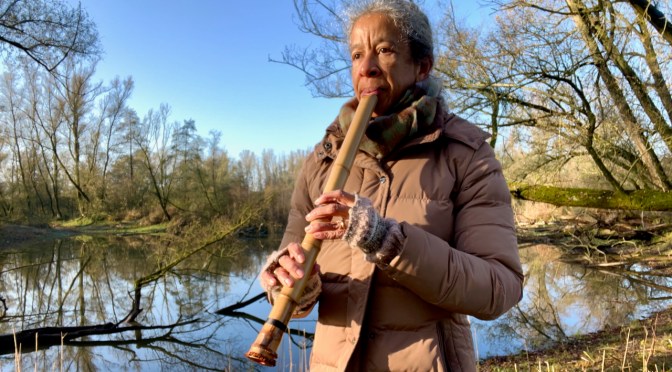
When I started playing in nature a few years ago, I quickly realised that I needed to learn my Honkyoku repertoire by heart. I wanted to be able to play anywhere, without relying on notation.
And then I made a huge discovery.
Why play Honkyoku by heart?
I wrote about this topic a few years ago (in this post), and looking back, I’m still using the same approach—only now, my repertoire has grown a lot.
Oral transmission
Traditional shakuhachi music is an oral tradition. Notation came later, mainly as a tool to remember and pass on the music. But you cannot truly play Honkyoku as it is meant to sound if you don’t know the style or have never heard it.
That’s why I make so many practice recordings for my students. You can find them on my SoundCloud page.
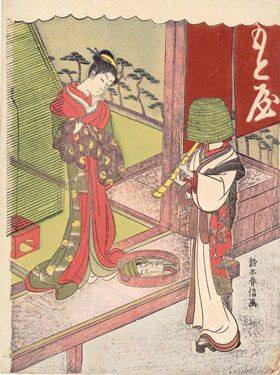
Playing by heart connects you more deeply to this tradition—and to yourself. Your listening shifts. You begin to follow in the footsteps of the Komusō monks.
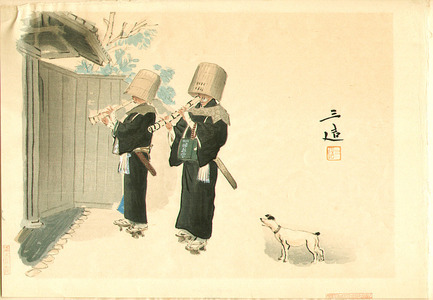
Reading notation feels, to me, like a very Western approach, similar to classical music. Have you ever seen African drum players reading notation? Their rhythmic polyphony is incredibly complex and precise, yet learned without sheet music. This is just one example, but if you look at traditional music from around the world, you’ll notice how rarely musicians perform with written scores.
Benefits of playing Honkyoku by heart
Focus
The first benefit is that I can dedicate much more attention to listening: to my breath, to the quality of the sound, to expression, and to the silence between phrases.
Repertoire
The more I play outdoors, the more my repertoire grows. I just pick up my shakuhachi and play my favourite pieces—no paper, no digital notation, no music stand needed.
Confidence
The more confident I become playing by heart in nature, the more confident I feel performing by heart in concert halls too.
In concerts in Europe and International Festivals, and even at the World Shakuhachi Festival in Texas, I performed by heart.
I often prepare for my performances in nature—like I did in Texas.
Even when I use notation, learning the piece by heart first gives me a deeper understanding of it and more room for expression.
Students’ feedback
I encourage my students to play by heart as well. Their feedback is always positive and valuable.
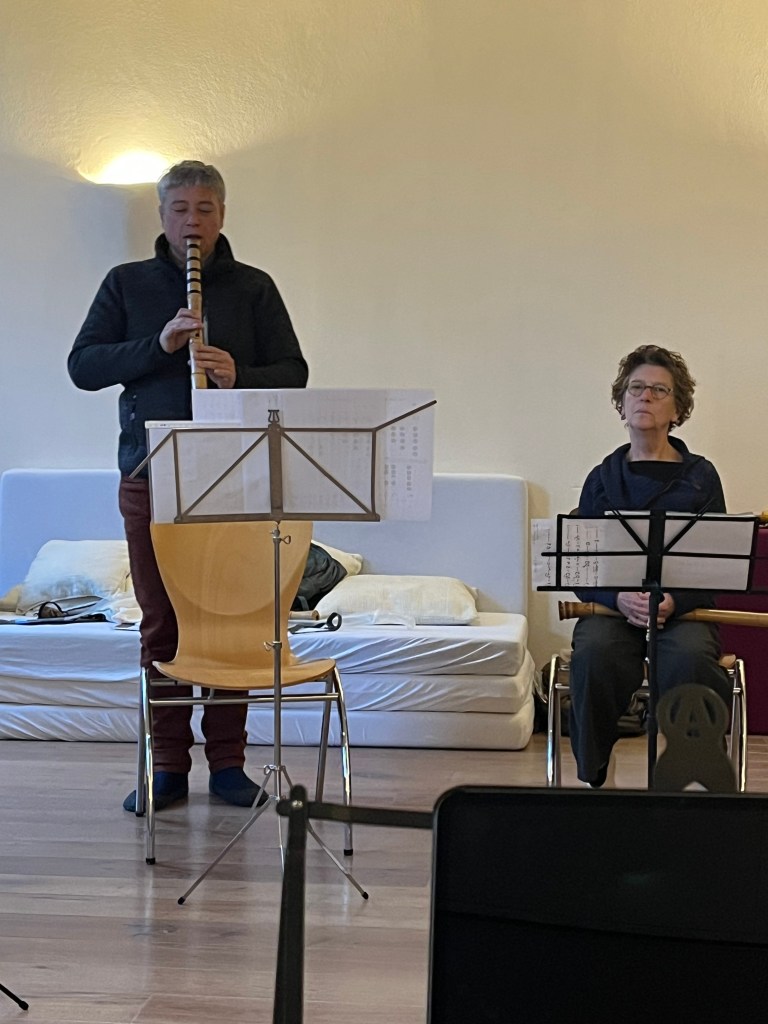
Last week, during a workshop, six of them performed by heart for the group. It was challenging, but magical to hear how each of them dared to express themselves through the music (the notations you see in the photos are from the group piece we were studying during the workshop; they are not the pieces the students performed for the group.)
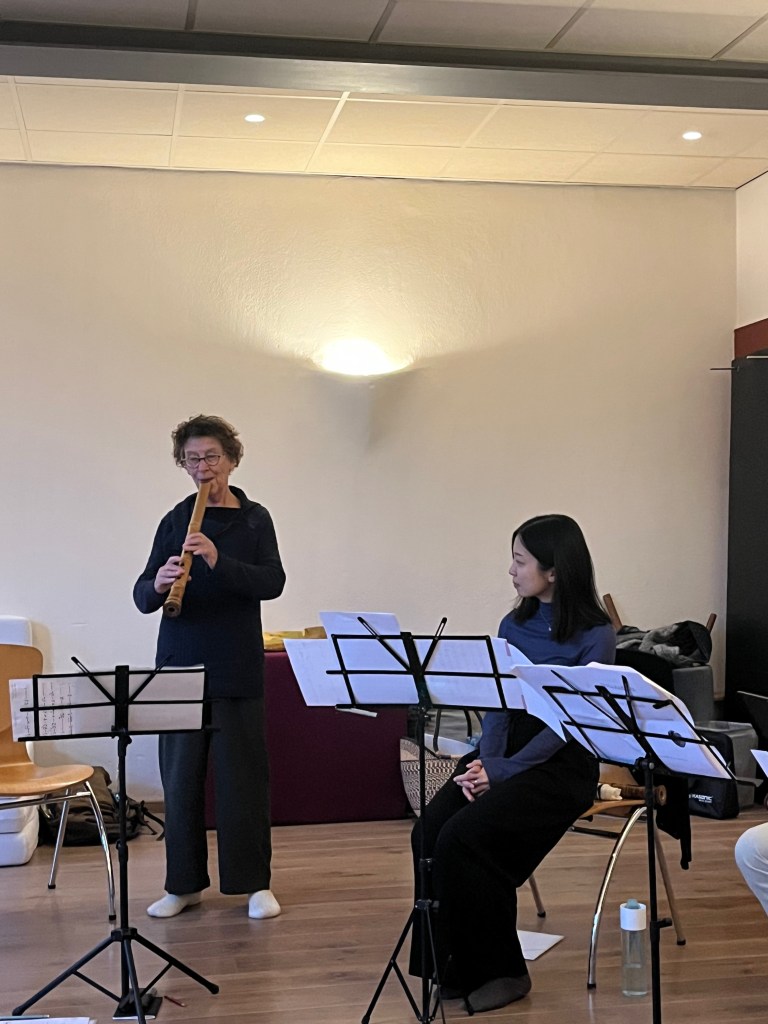
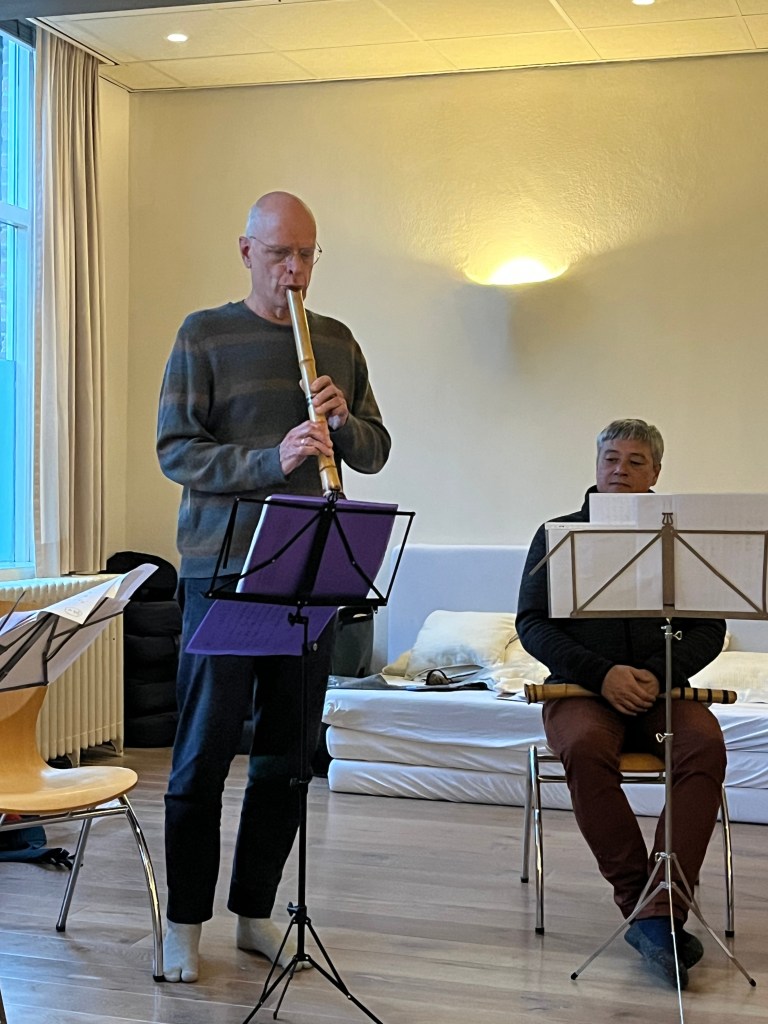


Of course, part of the attention goes into avoiding mistakes, and that can create tension. But the same happens when reading a score. Learning by heart brings you a step deeper into the music.
Why is it difficult to learn Honkyoku by heart?
Koten Honkyoku is not particularly melodic or rhythmic—not something you can sing easily like a song (although singing the phrases can help with phrasing).
The music is built on patterns, sound colours, and breath length.
Many patterns reappear across different pieces, sometimes with small variations. This makes it easy to mix pieces—starting one and ending with another! Practice helps reduce this.
Learning by heart will help you understand the music better and eventually make it your own.
Tips for Learning by Heart
1. The First Steps
- Study the piece thoroughly (with notation and recordings) until you can play it smoothly without hesitation.
- Look at the title: what is the piece about?
- Unfold the structure: where are the main sections? How do they transition?
- Build your own “story.” Not necessarily a literal story—just something that makes the phrases and sections feel logical rather than random.
The Next Steps
- Start with a short piece you know well.
- Play a phrase while looking at the notation, then repeat it with your eyes closed.
- Do the same with whole sections.
- Always know exactly where you are. Whether you’re a visual or auditory learner, don’t rely only on the logical flow. Have your internal “GPS” ready for when you lose your place.
=> Practice starting from different points—not just the beginning. You should be able to start anywhere and play to the end. - Learn from your mistakes:
– Why do they happen in a specific spot?
– Is it random, or does it happen often?
– What’s unclear in that phrase? - Record yourself and listen back with the notation. Fix inaccuracies.
- Play along with a recording and notice when you diverge.
- Go into nature and try again and again!
30-Minute Playing-by-Heart Challenge
I’m currently training my memory by starting each day with 30 minutes of Honkyoku played by heart.
Some pieces need refreshing, and I’m gradually adding new and longer ones.
Will you join the challenge?
Start with just 5 minutes a day and increase gradually.
I’d love to hear from you!
 Hélène Seiyu 聖 優 Shakuhachi
Thank you for these tips, I will include playing by heart in my daily practice!
LikeLiked by 1 person
Great! Happy playing by heart Daniele ❤️
LikeLike
Challenging Hélène, I’m in…
LikeLiked by 1 person