
As summer approaches – at least in my part of the world – I’m thrilled to announce that I’ll be teaching and performing at the European Shakuhachi Society Summer School in Finland from July 29th to August 1st! It promises to be an exciting opportunity for all involved.
When asked for my program, I selected two compositions by Fukuda Teruhisa sensei and two of my own compositions.
In a diverse summer school setting with various teachers and schools, I think our compositions would serve as an excellent introduction to the Hijirikai style, a modern school rooted in ancient tradition.
I’m excited to meet people in person again! If you’d like to join, click here to get all the information.

Shakuhachi Notation
Thinking about composition leads me to consider notation and various approaches to it.
1. Western music approach
When I studied classical flute at the city’s music school, I also studied music theory for many years: reading notes, rhythm, singing, chords, scales, tonalities, etc. I found music dictations challenging, especially when they weren’t purely rhythmical, and never learned properly to recognise chords. I believed that as a flutist, I didn’t need it as much anyway, and not having a piano at home made it difficult to learn. Sight-reading wasn’t a part of my training, reserved mainly for pianists and violinists, but there were times when I had to perform it. I became quite proficient at sight-transposing when playing in the music school’s jazzband with instruments in B flat or E flat such as saxophone, clarinets and trumpets.
In some other music schools, it was required to study music theory for one year before beginning to learn an instrument.
So all in all, music was mostly learned through notation and hardly through listening. When I reached a level where my flute teacher couldn’t demonstrate anymore the music I was studying, I had to imagine it. Rehearsals with piano just before end-of-year examinations were quite a shock because I had never heard the piano part before.
Please keep in mind that all of this took place before the advent of the Internet!! Additionally, I grew up in a small town.
I share this little story just to highlight how important music notation is in classical music studies.
When it comes to learning shakuhachi, how does it work?
2. Traditional Shakuhachi Instruction relies on oral transmission.
When it comes to learning shakuhachi, the approach is often quite different from classical Western music. While notation can still be used, oral transmission and learning by ear are more common in traditional shakuhachi instruction. Students often learn directly from a teacher through demonstration, imitation, and verbal instruction rather than relying solely on written scores. This oral tradition allows for a more nuanced understanding of the music, including subtle techniques, phrasing, and expression that may not be fully captured in written notation.
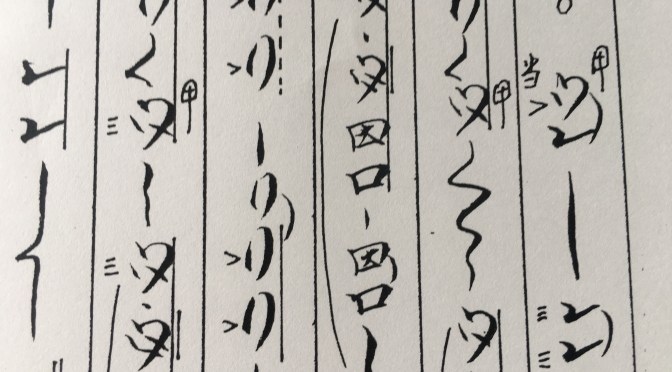
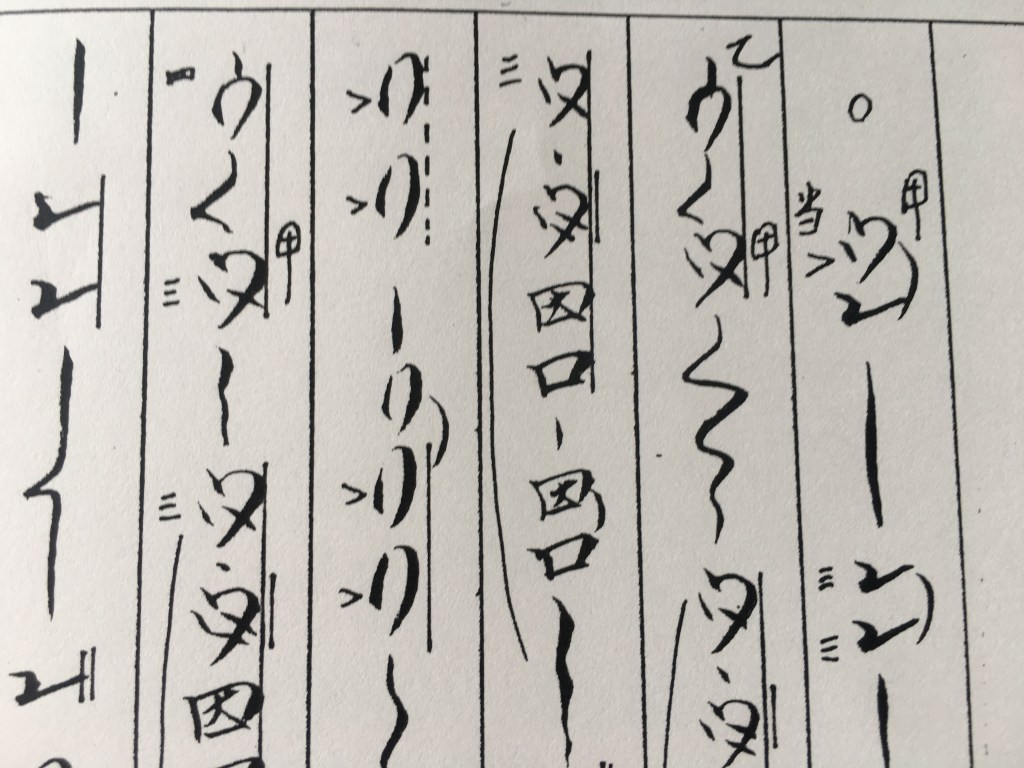
3. Traditional Shakuhachi Music is written is Japanese characters (Katakana)
How often are people surprised to learn that Japanese music is typically notated in Japanese characters rather than Western notation!
4. Every school has its own notation
When comparing different shakuhachi schools and notations, you’ll often encounter different characters for the same fingering or note, as well as the same character for a different fingering or note. This variability can indeed be confusing, especially for those new to the instrument or unfamiliar with a particular school’s terminology.
In international festivals or summer schools where participants may come from various schools and traditions, each school typically provides its own fingering chart or notation guide to ensure clarity and consistency within their specific approach. This helps students navigate the differences and understand how to interpret the music according to the teachings of each school.

5. Change in perspective
People may find traditional shakuhachi notation imprecise or challenging to interpret. However, I believe that traditional shakuhachi music is best learned through listening rather than solely relying on written notation. Listening allows students to capture the nuances of tone, phrasing, and expression that are integral to the music and may not be fully conveyed through notation alone.
That is the reason why I’ve recorded so many practice recordings to help my students practice the piece when there is no official recording by Fukuda sensei.
Within a specific shakuhachi tradition, certain aspects of the music are consistently played in a particular manner, therefore they don’t need to be written down. When someone learns a piece outside of its traditional context, they may miss out on these subtle nuances and may not fully understand how it should be played. Additionally, variations in pitch, particularly for meri notes, can differ between shakuhachi schools, further highlighting the importance of a guidance or at least, attentive listening.
Some musical elements are challenging to notate yet remain crucial aspects of the music, such as timbre (tone quality), colors, and even the nuanced execution of specific ornaments like Atari or Nayashi.
6. Notating my own compositions for shakuhachi
Additionally, as a composer, it’s incredibly challenging to notate every detail on a score without making it overly complex and difficult to read.
I recall dedicating significant time to mastering Berio’s Sequenza II, striving to execute each note with the precise accent, dynamic, and duration required, to achieve a seamless and flowing performance. Reading the score often proved to be an obstacle, and I eventually learned most of the piece by heart!

When I began notating my own compositions, I opted for Japanese notation, because the fingering gives more precision than only the pitch. I also wanted to preserve the rhythm based on breath division rather than beats and bars. Additionally, not every shakuhachi player can read Western notation.
A blend of Western notation with Katana indications is a viable alternative for those proficient in music editing software, which I am not.
Despite my somewhat childish Japanese calligraphy, I do believe that the handwritten aspect of notation and the calligraphy of a score convey more than just handwriting; they also reflect the character of the piece.

Before releasing the scores, I recorded all my music. The Easy Pentatonic Melodies and the Honkyoku for beginners have their own playlist on Soundcloud with mp3 to be downloaded.
The Japanese Meditations are recorded on my CD Reflection. I’ll be teaching two of them in Finland.

Writing down a notation is definitely the means to share the music. I was profoundly moved when I first heard one of my students playing my own compositions.
I’m eager to see how my classes in Finland will unfold!
7. Your experience with shakuhachi notation?
I’d be glad to hear your experience with shakuhachi notation. If you have any questions or would like to discuss this topic further, please feel free to share in the comments box below.
 Hélène Seiyu 聖 優 Shakuhachi
I too, have a background with western classical music (flute) along with jazz, blues and rock guitar. So, I also am fairly familiar with western notation.
I personally, found basic Japanese notation quick and easy to comprehend. I have transcribed a couple of Japanese simple pieces by ear, and I was able to notate them, using my wonderful Hijiri Kai fingering charts, provided in your Honkyoku for Beginners book.
LikeLiked by 1 person
Thank you Robert! I agree with you that Japanese notation is rather easy to learn and I think that you did very well to notate some tunes yourself. I sometimes encourage my students to practice writing the basic notes to learn them quicker. Writing music with them is even better! Thanks for this tip 🙏🏽
LikeLiked by 1 person
Wonderful
LikeLiked by 1 person